
Foamflower (Tiarella spp.) is one of the easiest shade perennials you can grow once you understand two things: it wants cool, moist, woodland-style conditions, and it repays almost zero maintenance with months of feathery white-to-pink blooms every spring. Plant it in partial to full shade in humus-rich, slightly acidic soil (pH 5.5–6.5), space plants 12–18 inches apart, keep the soil consistently moist, and you will have a healthy, spreading groundcover in its first full season. If you are starting from seed, plan for 8–12 weeks of cold stratification before germination. If you are dividing an established clump, do it in spring or fall and the new pieces will settle in before you know it.
How to Grow Foam Flower: Complete Guide to Tiarella Care

James Holloway
13 Jul 2026
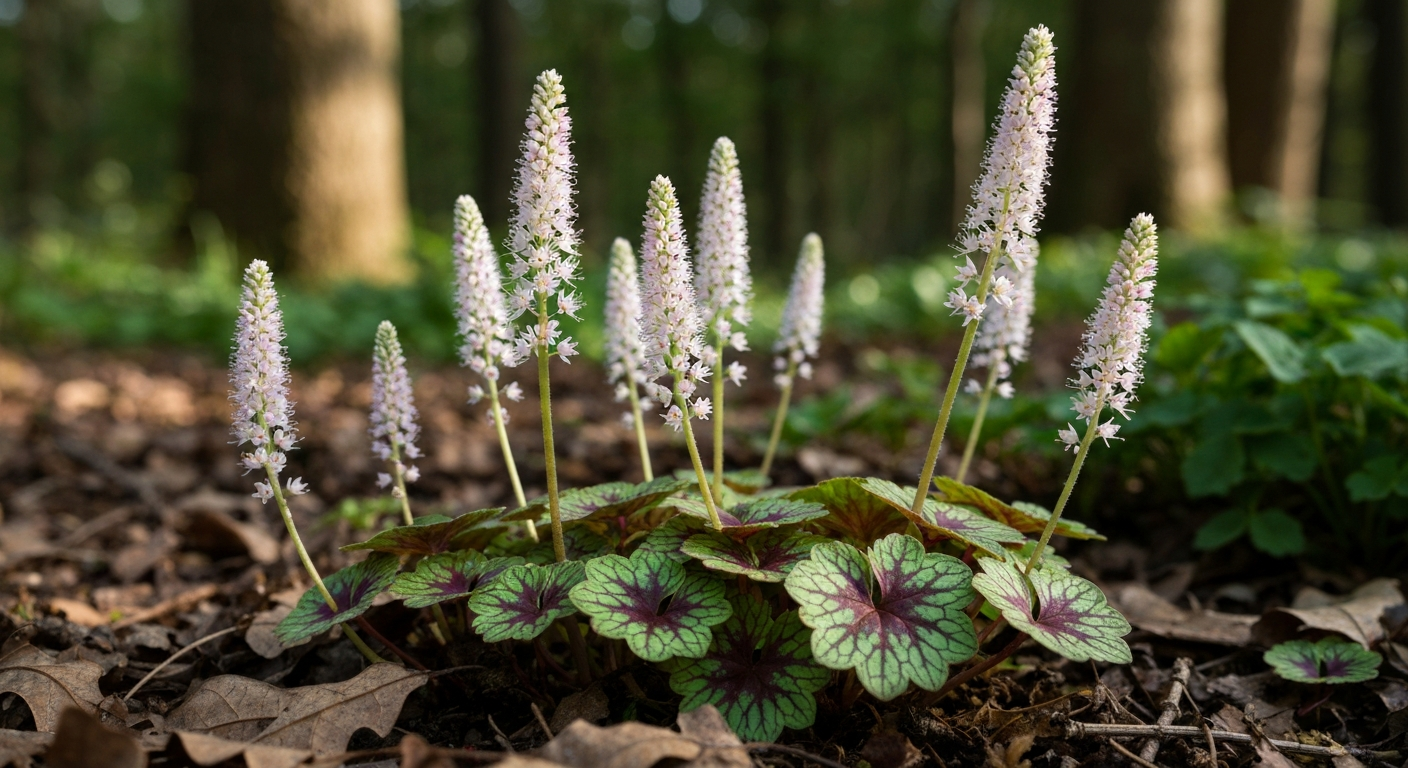
What is foamflower and why you should grow it
Tiarella is a small genus of herbaceous perennials in the saxifrage family (Saxifragaceae), native to temperate eastern North America and eastern Asia. The name 'foamflower' perfectly describes the look: in mid to late spring, airy racemes of tiny star-shaped white or pale pink flowers float above the foliage like sea foam on a wave. The plants form low rosettes or clumps of heart-shaped to deeply lobed leaves, typically 6–12 inches (15–30 cm) tall with spreads of 12–24 inches (30–60 cm), and the flower spikes can reach up to about 18 inches (45 cm). The University of Maryland Extension's Foamflower | University of Maryland Extension (Home & Garden Information Center) notes Tiarella leaves typically 6–12 in (15–30 cm) tall, prefers moist, highly organic soils, and blooms April–July on 3–4 in (7–10 cm) flower stalks. Outside of bloom time, the foliage, often marked with burgundy or bronze patterns along the leaf veins, is genuinely ornamental in its own right.
I grow foamflower under a canopy of mature oaks where almost nothing else wants to thrive, and it has become one of my most reliable plants. It stays evergreen or semi-evergreen in mild winters, fills gaps between hostas and ferns, and asks for almost nothing beyond moisture and an annual topdress of compost. For a beginner, it is a confidence builder. For an experienced gardener, it is a workhorse that earns its spot through every season.
Sorting out the name confusion before you buy
If you searched 'foam flower' and landed here, good. But it is worth flagging that several completely unrelated plants share similar or overlapping common names, and buying the wrong one is an easy mistake to make at a garden center or on a seed website. If you need guidance on another commonly mislabeled garden favorite, see our four o'clock flowers how to grow guide for tips on identifying and cultivating Mirabilis (four o'clock) correctly.
- Moonflower refers to Ipomoea alba, a night-blooming tropical vine in the morning glory family. It is a warm-season annual climber with large white trumpet flowers — nothing like Tiarella.
- Balloon flower is Platycodon grandiflorus, a sun-loving perennial with puffy balloon-shaped buds that pop open into purple, pink, or white bells. A separate guide covers it in detail.
- Four o'clock is Mirabilis jalapa, a heat-loving tender perennial with tubular flowers that open in the late afternoon. Completely different family, completely different growing conditions.
- Queen of the night most commonly refers to Epiphyllum oxypetalum, a tropical cactus with dramatic night-blooming flowers. Again, no relation to Tiarella.
- False miterwort or heart-leaf foamflower — these ARE Tiarella, just older or regional common names you may encounter on plant tags.
If you are researching any of those other plants, separate guides on moonflower, balloon flower, four o'clocks, and queen of the night will give you the specific growing instructions each one needs. For now, everything below is focused on Tiarella.
Choosing the right Tiarella for your garden
The genus has undergone recent taxonomic revision (Nesom, 2021), with some of what was broadly called Tiarella cordifolia now split into multiple species. For garden purposes, that mostly matters when you are hunting for regionally native plants. For most of us buying from nurseries, the cultivar selection is more practical than the species distinctions.
Key cultivar types at a glance
| Cultivar | Height x Spread | Key Feature | Habit | Hardiness Zones |
|---|---|---|---|---|
| 'Spring Symphony' | 6–12 in × 6–12 in (15–30 cm × 15–30 cm) | Compact, mid-to-late spring bloom | Clump-forming | 4–9 |
| 'Sugar and Spice' | 8–12 in × 12–18 in (20–30 cm × 30–45 cm) | Crimson central leaf marking, spreads by runners | Stoloniferous | 4–9 |
| 'Cutting Edge' | 8–10 in × 16–18 in (20–25 cm × 40–45 cm) | Deeply dissected, architectural foliage | Clump-forming | 4–9 |
| Tiarella cordifolia (species) | 6–12 in × 12–24 in (15–30 cm × 30–60 cm) | Classic heart-shaped leaves, vigorous spreader | Stoloniferous | 3–9 |
For groundcover use under trees, go with a stoloniferous type like 'Sugar and Spice' or straight Tiarella cordifolia, they send out strawberry-like runners that colonize gaps quickly. For defined clumps in a mixed border or container, a clump-forming cultivar like 'Spring Symphony' or 'Cutting Edge' is tidier and easier to manage. I have both in my garden and the stoloniferous ones cover more ground, but I do have to redirect the runners every spring to keep them where I want them.
Light, soil, and where foamflower actually thrives
Getting the light right
Foamflower genuinely prefers shade. Part shade (4–6 hours of direct sun, ideally morning sun with afternoon protection) and full shade (under 2–4 hours of direct sun) are both suitable. In hotter climates (zones 7–9), lean toward heavier shade to prevent leaf scorch. In cooler zones, a bit more sun is tolerated. The one thing that will visibly stress Tiarella fast is hot afternoon sun, especially in summer, leaves turn pale, curl, and look generally unhappy.
Soil: think woodland floor
The ideal soil for foamflower mimics the forest floor: humus-rich, moisture-retentive but well-drained, with plenty of organic matter. Aim for a slightly acidic pH of 5.5–6.5. If your soil is heavy clay, work in compost and coarse material to improve drainage before planting, wet, poorly drained soil in winter is the number one cause of root rot and plant loss. Conversely, sandy, fast-draining soils dry out too quickly; amend those with compost or leaf mold to hold moisture. A 2–3 inch (5–8 cm) layer of shredded leaf mulch around plants replicates woodland conditions beautifully and reduces watering needs.
Hardiness zones and regional notes
Most Tiarella species and cultivars are rated for USDA zones 4–9, with the straight species T. cordifolia sometimes listed as hardy to zone 3. If you are in zones 7–9, afternoon shade is non-negotiable and extra attention to soil moisture in summer will keep plants looking their best. In zones 3–5, the plants are tough and cold-hardy but appreciate a light mulch layer over winter to prevent frost heave.
Seed, division, runners, or cuttings: picking your propagation path
There are four ways to get more foamflowers. Each has a different time investment and success rate, so it is worth knowing which suits your situation before you start.
| Method | Best For | Pros | Cons | Time to Established Plant |
|---|---|---|---|---|
| Seed | Species types; budget-conscious; patient growers | Inexpensive; large quantities possible | Requires cold stratification; slow; cultivars may not come true | 12–18 months from seed to first bloom |
| Division | Any established clump 3+ years old | Fast; maintains cultivar traits; rejuvenates plant | Requires an existing plant; best done in spring/fall | Transplants bloom same or following season |
| Runners (stolons) | Stoloniferous cultivars like 'Sugar and Spice' | Easiest; runners root as they grow | Only works for runner-forming types | Rooted runners establish within one season |
| Root cuttings | Specialty propagation; increasing rare cultivars | Can work when division is not possible | Lower success rate; more technical | One growing season to a plantable size |
My honest recommendation: if you already have a clump, divide it. If you are starting from scratch, buy a plug or small pot from a nursery and then divide it in year two or three. Growing from seed is satisfying but the cold stratification requirement and long timeline mean it is a slow route to a garden full of plants. That said, if you are the patient type (and seed-starting is its own pleasure), the step-by-step below has everything you need.
What to gather before you start
Getting organized before planting day saves a lot of last-minute scrambling. Here is everything you should have ready, whether you are sowing seeds, dividing, or transplanting runners.
For seed sowing
- Fresh or stored Tiarella seed (viability drops after one year, so fresh seed germinates more reliably)
- Seed-starting tray or small pots with drainage holes
- Sterile seed-starting mix (fine-textured, low-nutrient)
- Resealable plastic bags and damp paper towels or perlite for stratification
- Refrigerator space for 8–12 weeks of cold stratification at 34–41°F (1–5°C)
- Labels and waterproof marker
- Small watering can with a fine rose head
- Plastic humidity dome or clear plastic wrap
- Timing: start cold stratification in late November to early January for spring sowing indoors; or sow directly outdoors in October to November to receive natural stratification
For division or transplanting runners
- Sharp garden knife or spade (sterilize with diluted bleach solution between cuts)
- Hand trowel
- Buckets of compost-amended soil or bagged compost for backfilling
- Watering can or hose
- Mulch (shredded leaves or fine bark), about 2–3 inches (5–8 cm) deep
- Containers (3–5 gallon / 11–19 L minimum for patio growing)
- For containers: a mix of roughly 50% quality potting mix, 20–30% perlite or pumice, and 10–20% compost or leaf mold
Timing quick reference by zone
| Task | Zones 3–5 | Zones 6–7 | Zones 8–9 |
|---|---|---|---|
| Begin cold stratification (indoor sowing) | Early December | Late November to early December | Late November |
| Sow indoors after stratification | Late February to March | February to early March | Late January to February |
| Outdoor direct sow (autumn) | October | October to November | November |
| Divide established clumps | Early spring or early fall | Spring or fall | Fall preferred (avoids summer heat) |
| Transplant rooted runners | Spring, after last frost | Spring or early fall | Early fall |
Growing foamflower from seed, step by step
Seed-grown foamflower is not difficult, but it does require patience and one important prep step: cold stratification. Tiarella seed has a dormancy mechanism that mimics what happens when seed falls to the forest floor in autumn and waits through winter before germinating in spring. Skip this step and you will likely get very poor or no germination.
Step 1: Clean and inspect your seed
Tiarella seeds are small and chaff-like. If you collected your own, separate the seed from dried flower stalks by rubbing them gently between your fingers over a sheet of white paper, the seeds are dark and slightly elongated. Remove any obvious debris. Store-bought seed is already cleaned. Check the packet date: seed older than one year may have noticeably reduced viability.
Step 2: Cold stratification (8–12 weeks)
Mix your seed with a small amount of barely damp perlite or a damp paper towel folded over the seeds, place it in a labeled resealable bag, and put it in your refrigerator at 34–41°F (1–5°C). Leave it for a minimum of 8 weeks, and 12 weeks is more reliable. Check every two weeks to make sure the medium stays barely moist (not wet) and to look for any early sprouting. If a seed sprouts in the fridge, pot it up immediately.
Step 3: Sowing
After stratification, sow seeds on the surface of moist seed-starting mix and press them gently into the surface, do not bury them deeply. A light dusting of fine vermiculite (about 1/8 inch / 3 mm) over the top is sufficient; many sources recommend surface sowing or near-surface sowing since Tiarella seed needs light to germinate. Space seeds roughly 1 inch apart in a tray or sow three to four seeds per small pot. Cover with a humidity dome or plastic wrap and place in a bright, warm location out of direct sun, aiming for around 65°F (18°C).
Step 4: Germination and early care
With proper stratification and warmth around 65°F (18°C), seedlings can begin emerging within roughly 2 weeks of being moved to warm conditions. Do not panic if some are slower, uneven germination is normal with Tiarella. Once seedlings show their first true leaves, remove the humidity dome and begin watering from below by setting the tray in a shallow dish of water. Fertilize lightly with a diluted, balanced liquid fertilizer at half strength once every two to three weeks.
Step 5: Hardening off and transplanting
When seedlings are 2–3 inches (5–8 cm) tall and have several true leaves, begin hardening off over 7–10 days by setting them in a sheltered outdoor spot for increasing periods each day. Transplant to a prepared garden bed or container once night temperatures stay above 40°F (4°C). Set the top of each rootball level with the soil surface, firm the soil around it, water thoroughly, and apply a layer of mulch around (but not touching) the stem.
Outdoor (direct) sowing
If you prefer to skip the indoor stratification process entirely, sow Tiarella seed directly into a prepared, lightly raked bed in October or November. The seeds will naturally stratify through winter and germinate the following spring. Mark the area clearly so you do not disturb it. This method is lower effort but gives you less control, and seedling emergence will depend on local winter temperatures and moisture.
Dividing established foamflower clumps
Division is the fastest and most reliable way to get new foamflower plants, and it has an added bonus: it rejuvenates an older clump that may have become congested in the center. I divide mine every three to four years in early spring, just as new growth is emerging, or in early fall when temperatures have cooled.
- Water the clump well the day before you plan to divide it so the roots are hydrated and the soil is workable.
- Use a sharp spade to cut around the outside edge of the clump, about 4–6 inches (10–15 cm) out from the crown, and lever the whole clump out of the ground.
- Set the clump on a flat surface and use a sharp knife or the spade to cut it into sections, each with at least 2–3 healthy shoots and a good root mass. Discard any dead or rotted central material.
- Replant divisions promptly — do not let the roots dry out. Dig holes large enough to accommodate the root mass without bending or cramping the roots.
- Set each division so the crown (where roots meet shoots) sits at the same depth it was before, roughly at or just below the soil surface.
- Backfill with amended soil, firm gently, and water thoroughly.
- Space divisions 12–18 inches (30–45 cm) apart. This allows mounding and, for stoloniferous types, room for runners to expand.
- Mulch around each division and keep the soil consistently moist for the first 4–6 weeks while roots re-establish.
Transplanting rooted runners
For stoloniferous cultivars like 'Sugar and Spice', rooted runners are almost too easy to propagate. In spring or early fall, trace a runner from the parent plant and find where it has rooted into the soil (it will feel anchored when you tug gently). Sever the connection to the parent plant with scissors or a knife, then lift the rooted section with a small trowel and transplant it exactly as you would a division. These small plants establish quickly and are usually indistinguishable from the parent by the end of their first season.
Day-to-day care once your plants are in the ground
Watering
Foamflower wants consistently moist (not wet) soil. Use 1 inch (25 mm) of water per week as your baseline, supplementing rainfall whenever it falls short of that. In hot, dry spells, especially in zones 7–9 during summer, increase frequency to keep the top 2 inches of soil from drying out completely. Mornings are the best time to water. Avoid wetting foliage in the evening, which can encourage fungal problems.
Mulching
A 2–3 inch (5–8 cm) layer of shredded leaves, fine bark, or leaf mold is one of the best things you can do for foamflower. It retains moisture, moderates soil temperature, gradually adds organic matter as it breaks down, and mimics the woodland conditions the plant evolved in. Top up the mulch layer each spring or fall, keeping it away from the crowns to prevent rot.
Feeding
Foamflower is not a heavy feeder. An annual topdress of compost in early spring is usually all it needs in a reasonably fertile soil. If your soil is particularly poor, a light application of a balanced slow-release fertilizer in early spring will help. Avoid high-nitrogen feeds that push lots of soft growth at the expense of the foliage patterning and flower production.
Deadheading and seasonal pruning
Deadheading spent flower spikes keeps the planting looking tidy and can sometimes encourage a second flush of bloom, though Tiarella is primarily a single-season bloomer. In late autumn, you can cut back any tatty or damaged foliage, but in mild zones the plants are semi-evergreen and the leaves provide some winter interest. In colder zones (3–5), I leave the foliage intact until early spring and then tidy up before new growth emerges.
Growing foamflower in containers
Foamflower works well in containers on a shaded patio or deck. For growers also interested in annuals and perennials suited to similar container conditions, see how to grow balloon flowers for guidance on growing Platycodon (balloon flower) in pots. The key rules are: use a large enough pot (3–5 gallon / 11–19 L minimum for long-term growing), use a well-draining mix, and never let the container dry out completely. A practical container mix is roughly 50% quality potting mix, 20–30% perlite or pumice for aeration and drainage, and 10–20% compost or leaf mold for moisture retention and nutrition. This mimics the woodland soil profile Tiarella prefers while preventing the waterlogging that kills it.
Container plants need more frequent watering than garden plants, check daily in summer and water whenever the top inch of mix feels dry. Feed with a balanced liquid fertilizer at half strength once a month during the growing season. In zones 3–5, protect container plants over winter by moving them to an unheated garage or insulating the pot with bubble wrap, as roots in containers are more vulnerable to freeze damage than roots in the ground.
Troubleshooting common problems
Root rot
This is the most common cause of foamflower failure. If plants look wilted, yellow, or simply melt away in winter or early spring despite adequate moisture, suspect root rot from poorly drained soil. Prevention is the best cure: improve drainage before planting by incorporating coarse organic matter and, if necessary, raising the planting area. If a plant is affected, dig it up, remove any rotted roots with a clean knife, dust the cut surfaces with powdered sulfur or cinnamon, and replant in a better-drained spot.
Slugs and snails
The soft foliage of young foamflowers is attractive to slugs and snails, particularly in damp spring conditions. Irregular holes in leaves, often with a slime trail, are the giveaway. Reduce hiding spots by keeping mulch away from crown level and removing any debris. Iron phosphate-based slug bait is effective and safer around wildlife and pets than metaldehyde products. You can also go out after dark with a flashlight and hand-pick them, tedious but satisfying.
Vine weevil
Root weevil (including black vine weevil) larvae feed on roots and can cause plants to suddenly wilt and die in late summer or fall. The adult beetles notch leaf edges in a characteristic curved pattern. In containers, they are especially problematic. Biological control with nematodes (applied in late summer when soil is warm, above 54°F / 12°C) is effective. In the garden, keeping clumps well-divided reduces the habitat weevil larvae prefer.
Leaf scorch and wilting in summer
If leaves look bleached, papery at the edges, or curl inward during summer, the plant is getting too much sun or drying out too fast. Move it to a shadier spot if possible or increase watering frequency and add extra mulch. This is not a disease, it is a cultural problem, and plants usually recover once conditions improve.
Your foamflower care calendar
| Season | Key Tasks |
|---|---|
| Early spring (zones 4–7: March–April) | Tidy old foliage; top up mulch with compost; apply slow-release fertilizer if needed; divide congested clumps; transplant rooted runners; begin hardening off indoor-started seedlings |
| Late spring / early summer (zones 4–7: May–June) | Enjoy bloom season; deadhead spent flower spikes; monitor moisture; watch for slugs and vine weevil adults |
| Summer (July–August) | Increase watering in dry spells; check containers daily; apply nematodes for vine weevil if needed |
| Early fall (September–October) | Second opportunity to divide clumps; transplant runners; sow seed outdoors for natural stratification; reduce watering as temperatures drop |
| Late fall / winter (November–February) | Light mulch over crowns in zones 3–5; carry out indoor cold stratification for spring sowing; protect containers in coldest zones |
A few final thoughts from the garden
Foamflower is one of those plants that rewards you far more than the effort you put in. Once it is established in a spot that suits it, dappled shade, moist, rich soil, it looks after itself, spreads gracefully, and delivers a genuine spring display that is hard to replicate with anything else in a shaded border. For tips on growing a different but similarly showy shade-loving plant, see how to grow fireblossom. If your first attempt does not go perfectly (maybe the seed germination was patchy, or a division sulked for a few weeks), do not be discouraged. Tiarella is forgiving, and even a struggling plant usually comes back with fresh vigor the following spring. Start with a healthy plug from a nursery, give it what it needs, and you will be dividing it to share with neighbors before long. For guidance on cultivating night-blooming species, see queen of the night flower how to grow. For guidance on a very different plant, see our guide on how to grow flower of the holy spirit. For guidance on another popular evening-blooming vine, see how to grow moonflower.
FAQ
What is foamflower (Tiarella) and where does it come from?
Foamflower (genus Tiarella) is a group of low, herbaceous perennials in the saxifrage family with lobed or heart‑shaped basal leaves and airy racemes of small white to pale pink flowers. Species are native to temperate eastern North America and parts of eastern Asia. Garden heights are typically 6–12 in (15–30 cm) with spreads of 12–24 in (30–60 cm); flower stalks can reach ~18 in (45 cm).
Which Tiarella cultivars are reliable for home gardens and which zones do they suit?
Good, widely available cultivars: 'Spring Symphony' (compact, 6–12 in, USDA zones ~4–9), 'Sugar and Spice' (stoloniferous, red leaf markings, ~8–12 in), and 'Cutting Edge' (deeply cut leaves, 8–10 in tall, wider spread). Most Tiarella perform across USDA zones roughly 3–9; many common garden cultivars are listed 4–9. Always check the specific nursery/RHS/Missouri Botanical Garden listing for the cultivar’s hardiness and habit before buying.
What light, soil and moisture conditions does foamflower need?
Light: medium to heavy shade or part shade—avoid hot afternoon sun. Quantitatively, aim for <4 hours direct sun (morning sun is acceptable). Soil: humus‑rich, well‑drained but moisture‑retentive woodland soil with plenty of organic matter. pH: slightly acidic, about 5.5–6.5. Moisture: keep consistently moist but not waterlogged; use ~1 inch (25 mm) supplemental water per week as a baseline, increasing in hot/dry weather.
When and how do I plant foamflower in the garden?
Best times: spring after last frost or fall (6–8 weeks before first hard freeze) for root establishment. Spacing: 12–18 in (30–45 cm) apart for spreading types. Planting steps: dig a hole twice as wide as the rootball, set crown level with soil surface, backfill with native soil amended with 20–30% compost or leaf mold, firm lightly, water thoroughly, apply 2–3 in (5–8 cm) mulch keeping it off the crown.
How do I grow foamflower from seed (timing and stratification)?
Timing: sow outdoors in autumn to use natural cold stratification, or stratify indoors. Stratification: cold‑moist stratify seeds for 8–12 weeks (store in damp peat/perlite at 34–41°F / 1–5°C). Sowing depth: surface sow or cover very lightly (no more than 1/8 in / 3 mm). Germination: after stratification, keep medium at ~65°F (18°C); seedlings often appear within ~2 weeks. Transplant when seedlings have 2–3 true leaves.
How do I propagate foamflower vegetatively (division, runners, root cuttings)?
Division: best in spring or fall. Lift clump, slice into sections with healthy shoots and roots, replant at original depth, water. Runners/stolons: many cultivars produce stolons—peg rooted stolons into soil or pot and sever after rooted. Root cuttings: take 2–3 in (5–8 cm) pieces in late winter from healthy plants, plant horizontally in potting mix with top covered lightly and keep moist; roots/shoots form in weeks. Always avoid transplanting in the heat of summer.
Next Articles
How to Grow Flower of the Holy Spirit: Step by Step
Step-by-step guide to grow Flower of the Holy Spirit from seed or cuttings to first blooms, with care tips and troublesh
Queen of the Night Flower How to Grow and Get Blooms
Step-by-step guide to grow queen of the night flower, prevent rot, and trigger reliable night blooms.
How to Grow Fireblossom: Seed to Bloom Guide
Step-by-step how to grow fireblossom from seed to bloom, including planting, care, and troubleshooting for fast results.