
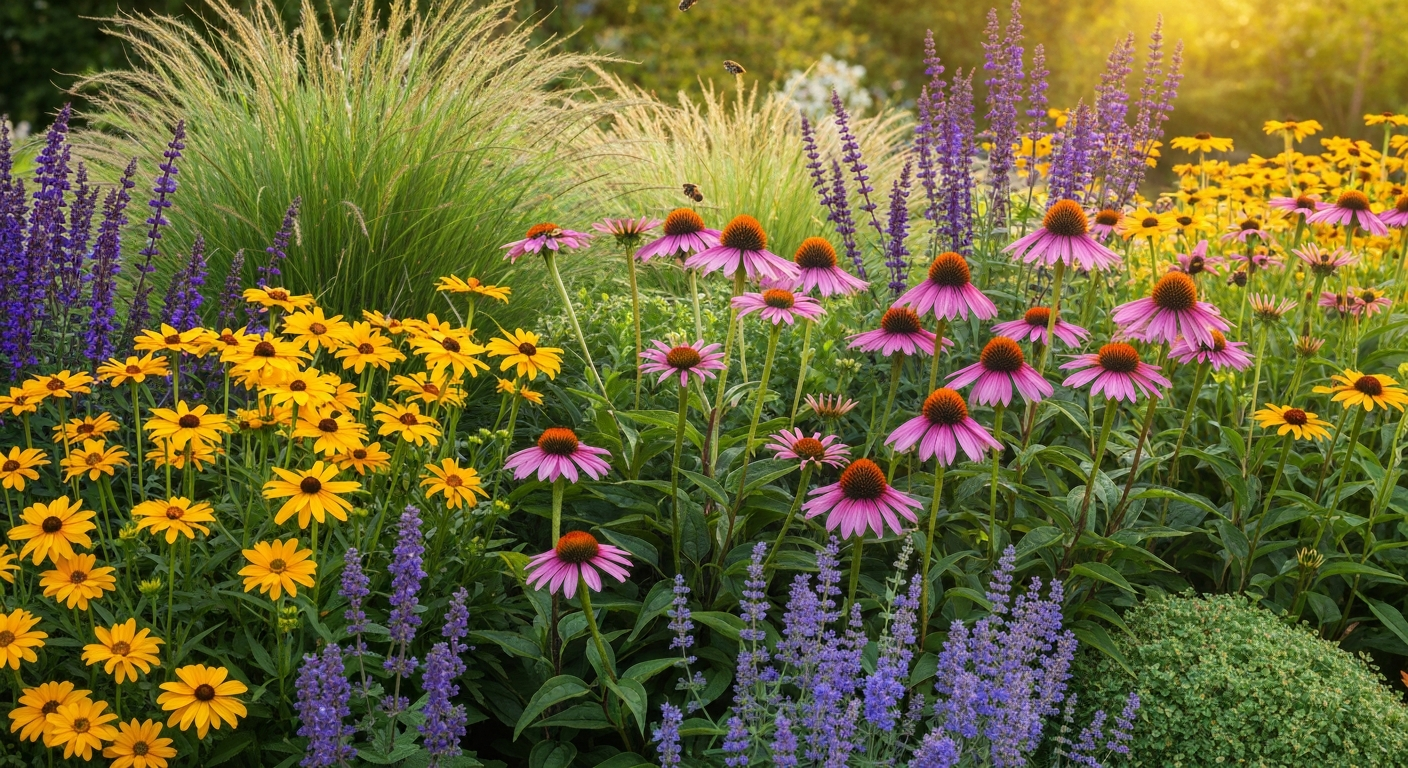
The best companions for coneflowers are plants that share the same love of full sun and well-drained soil: rudbeckia, salvia, yarrow, nepeta, cosmos, and ornamental grasses. These plants bloom in overlapping waves with Echinacea, fill gaps in your border beautifully, and attract the same bees and butterflies. Whether you want a low-maintenance perennial meadow, a cutting garden that keeps producing all summer, or a moody border anchored by near-black flowers, there's a combination here that will work for you.
What to Grow with Coneflowers: Companion Flowers & Design

James Holloway
17 Jul 2026
Why bother choosing companions at all?
Coneflowers (Echinacea purpurea and its relatives) are among the most forgiving perennials you can grow from seed. They establish readily, shrug off dry spells once their roots are down, and come back reliably in zones 3 through 9. But a bed of coneflowers alone can feel a little one-note. They peak in midsummer, go a bit leggy toward the end of the season, and leave visual gaps in spring and fall. The right companions fill those gaps, extend color from April through October, and turn a simple planting into something that looks genuinely designed.
There's also an ecological argument. Echinacea is a native pollinator magnet, especially for bumble bees and native solitary bees. Pair it with other nectar-rich flowers across a long season and you're essentially building a pollinator habitat rather than just a flower bed. I've tracked the difference in my own garden: years when I planted companion species alongside my coneflowers, the bee activity was noticeably higher from June all the way into October.
Quick picks at a glance
If you're short on time and want to know what to buy or sow right now, here's the summary. Full explanations follow in each section below.
| Category | Top Picks | Why They Work |
|---|---|---|
| Perennials | Rudbeckia 'Goldsturm', Salvia 'May Night', Nepeta 'Walker's Low', Yarrow 'Moonshine', Asters, Ornamental grasses | Matching sun/soil needs, overlapping or extending bloom, structural contrast |
| Annuals | Cosmos bipinnatus, Zinnia, Marigold, Tithonia (Mexican sunflower) | Continuous color, airy or bold texture, same dry-tolerant conditions |
| Cutting-garden staples | Snapdragons, Poppies, Sunflowers | Succession color, vertical accents, pollinator and bouquet value |
| Dark/black-flower accents | Chocolate cosmos (C. atrosanguineus), Black poppy 'Black Peony', Penstemon 'Dark Towers' | Dramatic contrast with bright coneflower pinks and oranges |
| Wildflower/meadow mix | Prairie dropseed, Wild bergamot (Monarda fistulosa), Lance-leaf coreopsis, Rudbeckia hirta | Native companion planting, extended pollinator season, low maintenance |
The perennial all-stars: plants that come back with your coneflowers every year
Perennial companions are the backbone of a coneflower planting. You invest once and they return, thickening up and improving every season. The key is matching their cultural needs: full sun to part shade, well-drained soil that doesn't stay soggy in winter, and moderate moisture. Here's what I keep coming back to.
Rudbeckia (Black-eyed Susan)
Rudbeckia fulgida 'Goldsturm' is practically made to grow next to Echinacea. It tops out at 2 to 3 feet, is hardy in zones 3 through 9, and blooms from late summer into fall, picking up right as coneflowers start to fade. The golden-yellow daisies with dark brown centers echo the shape of Echinacea blooms but in a warm contrasting color. I planted a 3-foot drift of 'Goldsturm' behind a row of Echinacea purpurea 'Magnus' and the combination was genuinely stunning in late August: deep pink next to bright gold. Both are drought-tolerant, both like the same soil, and neither needs babying.
Salvia (ornamental sage)
Salvia nemorosa or Salvia x sylvestris varieties, especially 'May Night' (sold as 'Mainacht'), give you deep violet spikes from late spring into early summer, well before most coneflowers hit their peak. That early bloom transitions beautifully as coneflowers take over, and if you shear the salvias back by about half after the first flush, they'll rebloom in late summer right alongside your Echinacea. Hardy in zones 4 through 9, they attract bees constantly, and that upright spike form provides a strong vertical element against coneflower's rounder, dome-shaped heads.
Nepeta (catmint)
Nepeta 'Walker's Low' is one of those plants that earns its keep over and over. It forms a soft, mounding clump of gray-green foliage with lavender-blue spikes and blooms for months when cut back after the first flush. Plant it at the front of a coneflower border and it softens the edge, bridges any gaps in bloom, and draws in bees like almost nothing else I've grown. It's deer-tolerant and drought-tolerant once established, which makes it a practical low-maintenance choice alongside Echinacea.
Yarrow (Achillea)
Yarrow occupies a slightly different niche: flat-topped flower clusters in yellow, cream, or soft pink that provide a strong horizontal contrast to the rounded coneflower heads. 'Moonshine' (bright yellow) and 'Coronation Gold' (deeper gold) are reliable varieties that hold their color well. Yarrow thrives in the same dry, well-drained soil that coneflowers prefer, and its ferny foliage adds fine texture between coneflower's broader leaves. It's also one of the best plants for beneficial insects: parasitic wasps and hoverflies are all over it.
Asters
Asters are the perfect seasonal handoff. Smooth aster (Symphyotrichum laeve) and New England aster (S. novae-angliae) bloom in September and October, right as coneflowers are finishing up. They extend the color in your border by 6 to 8 weeks and provide a critical late-season nectar source for migrating butterflies and bees preparing for winter. Plant them behind coneflowers so their leggy early-season growth is hidden by the shorter Echinacea in front.
Ornamental grasses
A clump of Little Bluestem (Schizachyrium scoparium) or Karl Foerster feather reed grass behind a drift of coneflowers gives the whole planting a sense of movement and depth that purely flowering plants can't provide. Grasses also provide winter structure: leave them standing through the cold months alongside the seed heads of Echinacea (birds love both) and you have a garden that looks intentional even in January.
Annuals and cutting-garden staples for season-long color
While perennials give you structure, annuals give you flexibility and abundance. These are the plants that fill in between established perennials, keep the vases full, and let you experiment with color combinations from year to year without committing long-term.
Cosmos
Cosmos bipinnatus is one of the best annuals you can grow alongside coneflowers. Its feathery, airy foliage is a perfect visual counterpoint to coneflower's bolder, coarser leaves and flowers, and it blooms continuously from midsummer until frost if you keep cutting. Cosmos is drought-tolerant once established, shares coneflower's preference for lean soil (over-fertilize and you get foliage at the expense of flowers), and grows 3 to 5 feet depending on variety. Direct sow after your last frost date: cosmos germinates in 7 to 10 days and blooms in about 8 weeks. For a succession cutting garden, sow a new batch every 2 to 3 weeks through early summer. If you're exploring what else pairs well in a cosmos-centered planting, the same companions that work here tend to overlap significantly. For more ideas on what to grow with cosmos, see our companion-planting guide on what to grow with cosmos. For more on caring for near-black cosmos like chocolate cosmos, see our concise guide on how to grow black cosmos acnh.
Marigolds
African marigolds (Tagetes erecta) in orange and deep gold make a bold, high-contrast pairing with pink and purple coneflowers. They're not the most sophisticated combination, but it's undeniably cheerful and very effective at drawing in pollinators. Marigolds also have the practical benefit of deterring some soil pests and they're extremely easy to grow from seed, making them a great first companion plant project for beginners. French marigolds (T. patula) work too and stay more compact, fitting neatly at the front of a coneflower border.
Poppies
Annual poppies (Papaver somniferum and P. rhoeas) are a spring-early summer treat that blooms before most coneflowers really get going. They need to be direct-sown in fall or very early spring since they require a cold period to germinate properly. They'll bloom and fade just as your coneflowers are ramping up, so there's a beautiful seasonal handoff rather than overlap. Once the pods ripen and the poppies die back, the coneflowers fill in and cover the gap. I treat poppy patches as spring punctuation marks in my coneflower border: scatter a packet every autumn and enjoy the surprise show each May.
Snapdragons
Snapdragons are a cool-season annual that gives you color in spring and again in fall (in climates where summer heat kills the spring flush). Their vertical spikes contrast sharply with coneflower's rounded domes and they're excellent cut flowers that keep a vase fresh for up to two weeks. Start snapdragon seeds indoors 10 to 12 weeks before your last frost date and transplant out once nighttime temps stay above 40°F. They'll bloom before your coneflowers even start and then the coneflowers take over seamlessly.
Zinnias and Mexican sunflower (Tithonia)
Zinnias are heat-lovers that peak right alongside midsummer coneflowers. Taller varieties like 'Benary's Giant' reach 3 to 4 feet and work beautifully as cutting companions. Mexican sunflower (Tithonia rotundifolia) is an underused choice: it grows 4 to 6 feet tall, produces vivid orange flowers, and is extremely heat and drought tolerant, making it a natural partner for established coneflowers in the hottest part of summer.
Dark and near-black flowers for drama and contrast
One of the most striking things you can do with a coneflower border is introduce a near-black or very deep maroon accent flower. The bright pinks, purples, and oranges of Echinacea pop dramatically against dark-toned companions. There are a handful of genuinely excellent options here. For a playful, game-inspired take on near-black blooms and pairing ideas, see a short guide on how to grow black flowers Animal Crossing for visual inspiration and contrast principles. For practical tips on selecting and cultivating very dark or near-black blooms, see our guide on how to grow black flowers.
Chocolate cosmos (Cosmos atrosanguineus)
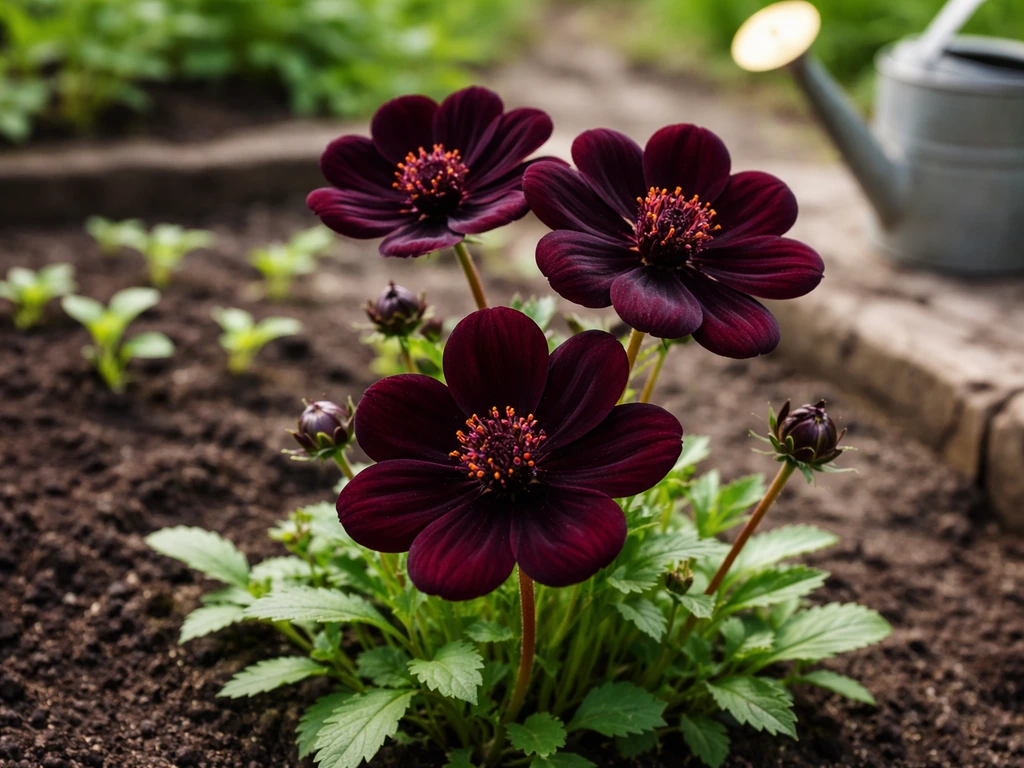
Chocolate cosmos produces flowers that are a deep maroon, almost black, with a faint chocolate scent that's entirely real and surprising. It's tuberous and technically perennial in zones 7 through 10, but in colder climates most gardeners treat it as an annual or lift the tubers before frost. It grows to about 18 to 24 inches, so it fits nicely in front of or beside mid-height coneflowers. The very dark blooms against rosy pink Echinacea is a combination I'd consider one of the most visually sophisticated in the entire cottage-garden repertoire.
Dark poppies
Papaver somniferum 'Black Peony' and 'Turkish Black' are direct-sown annuals with deeply saturated maroon-to-near-black double blooms that look spectacular in late spring and early summer before coneflowers dominate. Scatter seed in fall for spring bloom and let them self-sow year after year. Since their bloom season is earlier than coneflowers, they function as seasonal anticipation: dark drama in May, vibrant Echinacea color from July onward.
Penstemon 'Dark Towers' and 'Dakota Burgundy'
Penstemon 'Dark Towers' is a native-hybrid penstemon with near-black foliage that holds its dark color through the growing season. It produces pale pink tubular flowers in late spring on upright 3 to 4 foot stems, and that dark foliage provides a continuous moody backdrop even when not in bloom. It thrives in full sun and well-drained soil right alongside Echinacea, making it one of the most practical dark-accent perennials you can add to a coneflower planting.
If you're specifically drawn to the idea of dark and near-black flowers throughout the garden, there are entire planting strategies built around this aesthetic that go well beyond coneflower companions.
Wildflower and pollinator meadow combinations
If you're gardening in a more naturalistic or meadow style, coneflowers are actually one of the easiest entry points into a native planting. They're native to North American prairies and woodland edges and work seamlessly with other prairie natives. The key is choosing species that share their light and drainage preferences and bloom at different times so you get a continuous season of interest.
- Wild bergamot (Monarda fistulosa): lavender-pink flowers in midsummer, excellent for bees, native to prairies alongside Echinacea
- Lance-leaf coreopsis (Coreopsis lanceolata): bright yellow daisies in early summer, very drought tolerant, reseeds freely
- Prairie dropseed (Sporobolus heterolepis): a fine-textured native grass that makes a beautiful soft contrast to the bold Echinacea blooms
- Rudbeckia hirta (black-eyed Susan, annual/biennial): easy from seed, blooms first year from spring sowing, covers ground between coneflowers while they establish
- Prairie blazing star (Liatris spicata): tall purple spikes that bloom from the top down, stunning vertical companion, zones 3–9
- Rattlesnake master (Eryngium yuccifolium): spiky silver-green spheres that add structural drama and textural contrast
For a true pollinator meadow, aim for at least 3 to 5 species that bloom in sequence from May through October. Coneflowers anchor the midsummer peak, but you want something blooming before them (coreopsis, wild bergamot) and something taking over after (asters, native grasses going to seed). Keep in mind the Xerces Society's caution about cultivar choice: straight species Echinacea purpurea and E. angustifolia provide far better nectar and pollen access than heavily modified double-flower hybrids. Save those fancy cultivars for purely ornamental spots and use straight species in your pollinator plantings.
Why these combinations actually work: matching the basics
Good plant combinations aren't just about what looks pretty together, though that matters. The plants have to actually want to grow in the same conditions. Here's why the companions listed above work in practice, not just in theory.
| Factor | Coneflower needs | Compatible companions match |
|---|---|---|
| Light | Full sun to part shade (6+ hours ideal) | Rudbeckia, salvia, nepeta, cosmos, yarrow, marigolds all prefer full sun |
| Soil | Well-drained, average to poor fertility; tolerates clay or sand once established | All recommended companions share this preference; avoid companions that need rich, moist soil |
| Water | Drought-tolerant once established; moderate during establishment year | Cosmos, yarrow, nepeta, marigolds share drought tolerance; avoid water-demanding companions |
| Bloom time | Midsummer to early fall (June–September peak) | Salvia and snapdragons cover spring; rudbeckia and asters extend into fall |
| Height | 2–4 ft depending on variety; space 18–24 inches apart | Nepeta and marigolds for front; coneflowers and cosmos mid; grasses and tithonia for back |
| Pollinator value | High for native bees, bumble bees; lower for double/hybrid cultivars | Salvia, nepeta, yarrow, wild bergamot all add nectar across different flower structures |
The spacing recommendation of 18 to 24 inches between coneflower plants is about more than just giving them room: adequate airflow is one of the key defenses against Sclerotinia stem rot, which can cause plant collapse in cool, wet conditions. When you're designing companions in, build that airflow spacing into the whole bed rather than crowding everything together for a fuller look. A slightly open planting in spring fills in by midsummer anyway.
Design ideas: color, texture, height, and using dark accents well
Designing a coneflower planting that looks intentional rather than accidental comes down to a few principles. You don't need to be a trained designer to apply them: they're just practical rules that make the difference between a muddle and a composition.
Height layering: front, middle, back
Place shorter plants (nepeta, French marigolds, yarrow at 12 to 18 inches) at the front of the border, coneflowers and cosmos in the middle (2 to 4 feet), and tall grasses, tithonia or sunflowers at the back (4 to 6 feet). This is the classic approach and it works because it means every plant is visible, not because it's the only way to do it. In island beds, reverse engineer from the center outward with the tallest plants in the middle.
Drift planting for a natural look
Rather than dotting single plants throughout, plant each species in drifts of 3, 5, or 7 (odd numbers read more naturally). A drift of 5 coneflowers next to a drift of 5 rudbeckia and anchored by a clump of Karl Foerster grass looks like it grew that way. This is especially effective in meadow-style plantings where you want the border to feel relaxed rather than formal.
Color contrast: how to make coneflower pink sing
The warm pink of Echinacea purpurea contrasts well with violet-blue (salvia, nepeta, asters), bright gold (rudbeckia, yarrow, marigolds), and deep dark maroon or near-black (chocolate cosmos, dark poppies, dark penstemon). The classic cottage combination is pink plus gold plus purple/blue, and coneflowers make that simple to execute. For a more sophisticated or moody scheme, anchor the planting with dark-foliage or dark-flowered companions and let the bright coneflower heads pop against them.
Texture contrast: round heads, spikes, and fine foliage
Coneflower blooms are bold, raised-center daisies with a distinct architectural shape. They pair best with contrasting forms: the flat plates of yarrow, the upright spikes of salvia and liatris, the airy clouds of cosmos or ornamental grasses. Avoid planting large-daisy companions directly adjacent to coneflowers (rudbeckia is an exception because of the strong color contrast) since same-shape pairings can read as visually flat.
Using dark flowers as focal points, not just fillers
Dark flowers work best when you use them deliberately: a single clump of chocolate cosmos placed where a path turns, or a trio of 'Dark Towers' penstemon used as a structural vertical accent at the corner of a coneflower border. Used throughout a planting, very dark flowers can feel heavy; used as punctuation marks they create drama. Think of them as the equivalent of a dark-colored piece of furniture in a light-colored room: one or two anchor the space, fifteen overwhelm it.
Succession cutting for bouquets through the season
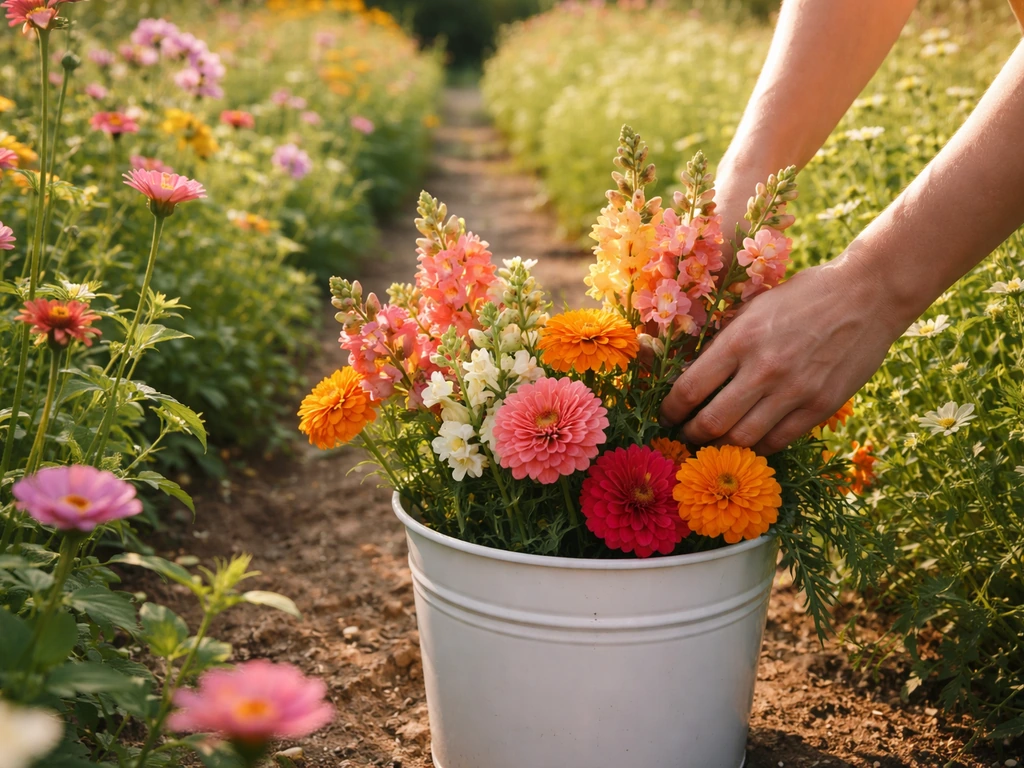
If you're growing this combination for cut flowers, plan your succession sowing around the coneflower bloom window. Coneflowers peak July through September. Start snapdragons indoors in February or March for April-May cutting. Direct-sow cosmos every 3 weeks from last frost through late June to ensure fresh growth through fall. Sow zinnias in May for August cutting. Coneflowers themselves last 7 to 10 days in a vase and the dried seed heads are useful in autumn arrangements alongside ornamental grass plumes.
Timing and seed-starting schedule by zone
| Plant | Start method | Zone 5–6 timing | Zone 7–8 timing | Notes |
|---|---|---|---|---|
| Echinacea (coneflower) | Direct sow or transplant | Start indoors Feb–Mar; transplant May | Direct sow Mar–Apr or transplant Mar–Apr | Cold stratify seeds 4–6 weeks for best germination; blooms year 2 from seed |
| Cosmos | Direct sow after frost | Direct sow mid-May; succession sow to late June | Direct sow Mar–Apr; succession sow to May | Germinates in 7–10 days; blooms in 8 weeks |
| Rudbeckia 'Goldsturm' | Transplant or division | Plant out May–Jun | Plant out Mar–Apr or Sep | Easiest from purchased plants; established quickly |
| Salvia 'May Night' | Transplant | Plant out Apr–May | Plant out Mar–Apr | Buy as transplant or divide established clumps |
| Snapdragons | Start indoors | Start indoors Feb–Mar; transplant Apr | Start Nov–Jan; transplant Feb–Mar | Needs light to germinate; do not cover seeds |
| Poppies (Papaver somniferum) | Direct sow | Sow Sep–Oct or early Mar | Sow Oct–Nov or Feb | Needs cold to germinate; scatter on soil surface |
| Marigolds | Direct sow or transplant | Direct sow after last frost (mid-May) | Direct sow Mar–Apr | Fastest from transplant; germinates in 5–7 days |
| Nepeta 'Walker's Low' | Transplant or division | Plant out Apr–May | Plant out Mar–Apr or Sep | Divide in spring for free plants; shear back after first bloom |
| Chocolate cosmos | Tubers/transplant | Plant tubers May after frost | Plant tubers Mar–Apr | Lift tubers before frost in zones below 7 |
Quick troubleshooting: pests and diseases to watch for
Most coneflower plantings are remarkably trouble-free, but there are two problems worth knowing about before they catch you off guard.
Aster yellows
Aster yellows is a phytoplasma disease transmitted by aster leafhoppers. The symptoms are hard to miss: coneflower heads become distorted, greenish, and leafy-looking instead of forming normal petals. Once a plant is infected, there is no cure. Remove and dispose of affected plants immediately (don't compost them) and control leafhoppers with yellow sticky traps. Reducing weeds around the planting is also effective since many weeds serve as reservoirs for the pathogen. I lost several coneflowers to aster yellows one summer before I understood what was happening, and prompt removal of infected plants genuinely stopped the spread.
Sclerotinia stem rot
Sclerotinia causes sudden stem collapse, usually at or near the soil line, in cool wet conditions. The affected tissue looks water-soaked and may have white fluffy fungal growth. The best defenses are preventive: space plants properly (that 18 to 24 inch guideline matters here), avoid overhead watering on cool days, and remove any infected plant material immediately. Don't let fallen leaves or old stems pile up around the crown over winter.
A note on cultivar choice for pollinators
If pollinator support is part of your goal, the Xerces Society's research is worth paying attention to: heavily modified double-flower Echinacea cultivars and many of the brightly unusual hybrid colors may offer significantly less nectar and pollen than straight species. See Picking Plants for Pollinators: The Cultivar Conundrum, Xerces Society blog for details on how modern Echinacea cultivars (doubles and heavily hybridized color forms) can reduce nectar and pollen rewards for pollinators Picking Plants for Pollinators: The Cultivar Conundrum — Xerces Society blog. For a pollinator planting, stick with Echinacea purpurea, E. angustifolia, or single-flower cultivars that maintain normal flower architecture. Save the more theatrical double forms for containers or spots where the look is the main point.
FAQ
What are the best companion plants for coneflowers (Echinacea)?
Try a mix of perennials and annuals that share full sun, well‑drained soil and moderate moisture needs: Rudbeckia (Goldsturm), Salvia (May Night), Nepeta (Walker's Low), Achillea (yarrow), ornamental grasses, and asters for perennial structure; cosmos, zinnia, tithonia and snapdragons as warm‑season annuals and cut‑flower fillers. Also consider marigolds, poppies and penstemon for additional color and form.
Why do these plants pair well with coneflowers?
They match key cultural needs (full sun to part shade, well‑drained soil, drought tolerance once established), have complementary heights and bloom times, and offer varied textures that enhance visual contrast. Many also attract pollinators—bees and butterflies—that visit Echinacea, while sturdy forms (rudbeckia, salvia, grasses) provide structure and support for cutting gardens.
How should I space and position coneflowers and their companions?
Space Echinacea plants about 18–24 inches (45–60 cm) apart to promote airflow and reduce disease. Plant taller companions (ornamental grasses, tall rudbeckia) behind coneflowers in beds, mid‑height plants (salvia, penstemon) beside or mixed in, and low mounds (nepeta, thyme) at the front. Stagger heights in drifts for a natural prairie/cottage look.
What seed‑starting and planting schedule works for a mixed coneflower bed?
Perennial coneflowers: start seeds indoors 8–10 weeks before last frost or direct sow in fall/early spring. Many perennial companions (salvia, nepeta, yarrow) are started indoors in late winter or direct sown in spring. Annuals (cosmos, zinnia, tithonia) are direct-sown or started indoors 4–6 weeks before last frost and succession-sown every 2–3 weeks to extend bloom. For cutting succession, begin annual sowing at last frost and continue at 2–3 week intervals through early summer.
How do I plant and establish new coneflowers and companions?
Choose a sunny site with well‑drained soil. Amend heavy soil with compost for drainage. Dig holes as deep as the rootball, backfill, and water thoroughly. Mulch 2–3 inches to conserve moisture but keep mulch away from crowns to avoid rot. Water regularly until established (first season), then reduce frequency—Echinacea tolerates dryer conditions once mature.
What maintenance, watering and fertilizer tips should I follow?
Water deeply and infrequently—about 1 inch per week when establishing; reduce after establishment. Avoid overwatering and poor drainage. Fertilize lightly in spring with a balanced slow‑release fertilizer or a handful of compost—excess nitrogen leads to floppy growth. Deadhead spent annuals to prolong bloom; for perennials, remove seedheads if you don’t want self‑sowing but leave some for birds and winter interest.
Next Articles
How to Grow Black Flowers From Seed to Bloom
Step-by-step guide to grow near-black blooms from seed to flowering, with soil, light, watering, and troubleshooting.
Floret How to Grow Ranunculus: Step-by-Step Guide
Step-by-step Floret-style ranunculus guide: corm prep, planting, watering, frost care, troubleshooting, and harvest for
How to Grow Your Own Wedding Flowers Step by Step
Step-by-step guide to grow bouquet-ready wedding flowers, from planning and sowing dates to harvesting, conditioning, an