
To grow black cosmos in Animal Crossing: New Horizons, plant two orange cosmos next to each other so they share the same 3x3 tile neighborhood, water them every day, and wait. Each daily reset gives roughly a 6.25% chance of a black cosmos offspring appearing on a nearby empty tile. It takes patience, but once you have one black cosmos you can clone it quickly by isolating it from other flowers and keeping it watered.
How to Grow Black Cosmos ACNH, Breeding Guide, Layout & Tips

James Holloway
6 Aug 2026
Why bother with black cosmos (and who this guide is for)
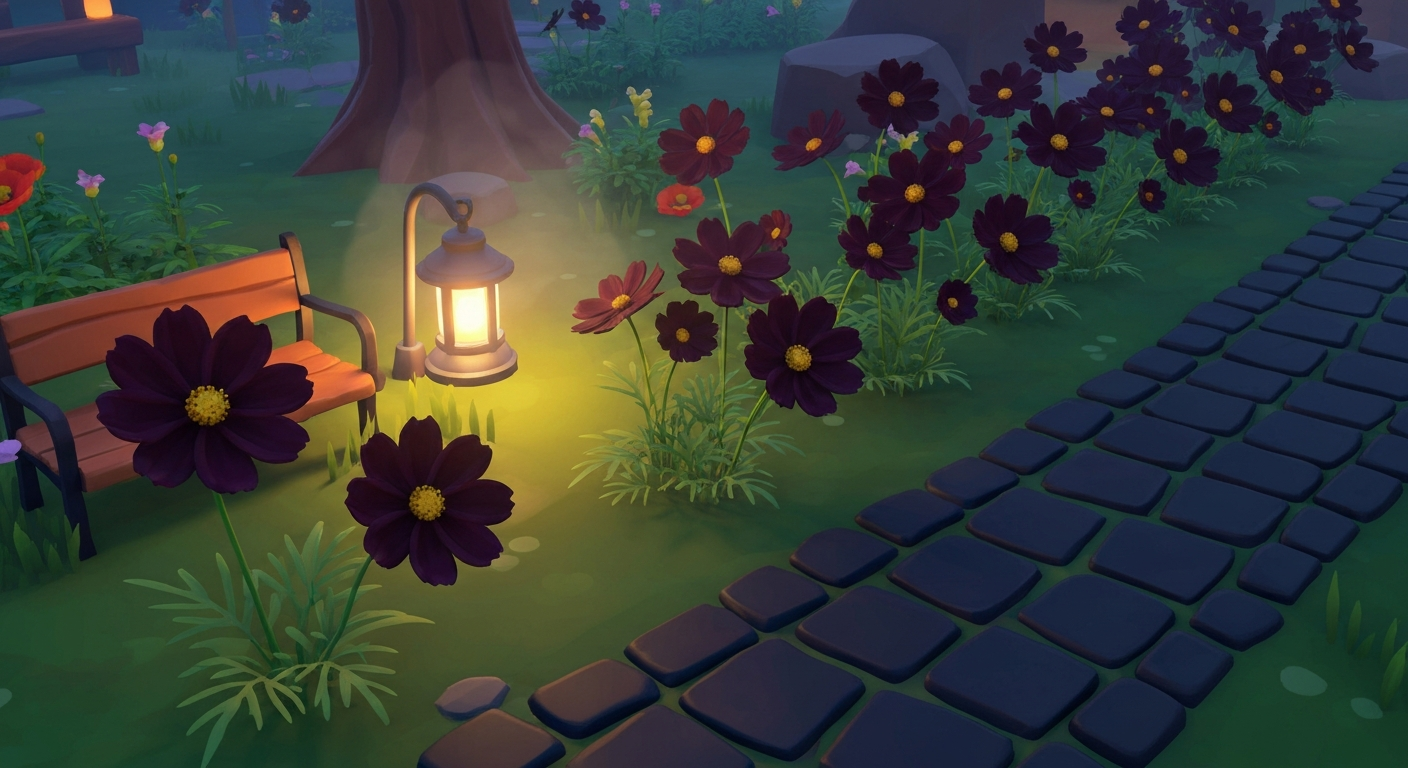
Black cosmos are one of the rarest and most dramatic flowers in ACNH. They show up as deep, almost-black burgundy blooms and instantly add a gothic, moody aesthetic to any island corner or garden path. If you have been building a dark-themed island, a graveyard nook, or just want a striking contrast against white or gold flowers, black cosmos are the flower to chase. This guide is written for players who are new to ACNH flower breeding, not just those with spreadsheets and a genetics background. I will walk through exactly what parents you need, how to arrange them, what to do every single day, and what to check when nothing seems to be working. If you are also curious about other dark flowers in Animal Crossing, there is a wider world of black blooms beyond cosmos worth exploring. For a broader walkthrough covering other black blooms and step-by-step tips, see our guide on how to grow black flowers in Animal Crossing.
What to expect: rarity, uses, and the honest reality
Black cosmos are a hybrid flower, meaning the game generates them through a breeding roll rather than selling them in Nook's Cranny. The base chance from the most common orange-plus-orange pairing is around 6.25% per day per eligible pair, dropping to roughly 4.7% depending on the exact hidden genotypes your oranges carry. That means on any given day you might get nothing, and you will often go several days in a row without a single black bloom. That is completely normal. The reward, though, is a flower you can clone indefinitely once you have a single specimen, so the grind is front-loaded. For island design, black cosmos work beautifully as accents along dark garden paths, near mystery island or cemetery builds, or as a companion to black roses and black tulips.
What you need before you start
Before placing a single flower, gather your materials. You need orange cosmos as your breeding parents, and the cleanest way to get reliable orange cosmos is to breed them yourself from seed-bag flowers. Seed bags from Nook's Cranny give you flowers with known, fixed genotypes, which is important because different orange genotypes produce black cosmos at very different rates.
- Red cosmos seed bags (from Nook's Cranny or a friend's island shop)
- Yellow cosmos seed bags (same source)
- At least 4 to 6 open planting tiles on your island, ideally in a dedicated breeding plot away from other cosmos
- A watering can (copper or better is fine for single-island play; gold watering can is not required)
- Access to online friends or visitors willing to water your flowers for a breeding speed boost (optional but very helpful)
Your island does not need any special condition beyond having open soil tiles. You can plant in the ground anywhere on your island, including terraformed areas. Keep your breeding plot well away from any other cosmos you have growing for decoration, because stray cosmos nearby can interfere with your pairings by becoming unintended breeding partners.
Step-by-step breeding recipe
Stage 1: make seed oranges from red and yellow
- Buy red cosmos seeds and yellow cosmos seeds from Nook's Cranny. These seed-bag flowers have fixed, known genotypes, which is the whole point of starting here rather than picking up random orange cosmos from mystery islands.
- Plant one red cosmos directly next to one yellow cosmos so they share the same 3x3 area (i.e., they are within one tile of each other).
- Water both plants every day. Leave at least one empty tile adjacent to either parent for the offspring to spawn.
- Wait for an orange cosmos to appear. This cross (red seed + yellow seed) reliably produces orange offspring. These are your 'seed oranges' and they carry a specific genotype that makes them useful for the next stage.
Stage 2: breed orange from orange to get black
- Once you have at least two orange cosmos from the red-yellow cross above, move them into your dedicated breeding plot and plant them adjacent to each other with one or two empty tiles nearby for offspring.
- Water both oranges daily. Each day at the 5: 00 AM game reset, the game rolls a reproduction chance for each hydrated flower.
- At a base of around 6.25% per pair per day, expect to wait anywhere from a few days to a couple of weeks for a black cosmos to appear. It will show up as a new bloom on an empty adjacent tile.
- When a new cosmos sprouts, do not assume it is black right away. Let it reach full bloom stage (it takes one day to open after appearing as a bud) before confirming the color.
- If the offspring is orange rather than black, that is normal. Move unwanted orange offspring out of your breeding plot immediately so they do not become accidental third parents.
Stage 3 (optional but recommended): the clone-pair method for higher odds
Community breeders have documented a multi-generation method called the clone-pair method that can push black cosmos odds up to around 25% per pair per day. The idea is that some orange cosmos genotypes, when paired together, have much better black offspring odds than the standard 6.25%. To use this method, you breed several orange cosmos from your Stage 1 seed oranges, then test-pair different orange combinations. You are looking for 'special' oranges that consistently produce black offspring at a higher rate. Once you identify a strong orange pair, you isolate each parent individually (no adjacent same-species neighbors) to clone them, building up a stock of genetically identical oranges. Then you pair those clones together as your production pair. This takes longer to set up but pays off significantly if you want multiple black cosmos quickly. Community tools like the gardenscience.ac simulator can help you work out which orange genotypes you are likely dealing with.
Parent combinations and odds at a glance
| Parent A | Parent B | Offspring that can include black | Approximate black odds per day | Notes |
|---|---|---|---|---|
| Orange cosmos (seed-orange genotype) | Orange cosmos (seed-orange genotype) | Black, orange | ~6.25% | Reliable starting point; seed bags give known genotypes |
| Orange cosmos (certain hybrid genotype) | Orange cosmos (matching hybrid genotype) | Black, orange | ~4.7% to ~6.25% | Varies; avoid randomly sourced mystery-island oranges without testing |
| Special orange (clone-pair method) | Special orange (clone-pair method) | Black, orange | Up to ~25% | Requires multi-generation setup; highest practical yield |
| Red cosmos (seed) | Yellow cosmos (seed) | Orange only | No black possible | Stage 1 only; produces the seed oranges you need |
Island layout and planting diagrams
Where and how you arrange your parents matters more than most beginners expect. The game checks the 3x3 area of tiles surrounding each flower when it looks for a breeding partner. If a third cosmos sits within that zone, it creates multiple possible pairings and can reduce your targeted pair's output, or cause a parent to clone itself instead of breeding with your chosen partner.
The simple pair layout
The easiest setup is to place your two orange parents side by side in a row with at least one empty tile on the remaining sides. Think of it like this: O = orange cosmos, E = empty tile.
- Row layout: [E][E][E] / [E][O][O] / [E][E][E] — both oranges are adjacent, all surrounding tiles are empty for offspring to appear
- Keep at least a two-tile buffer between this pair and any other cosmos on your island
- If you want multiple pairs running simultaneously, space each pair at least three tiles apart so their 3x3 neighborhoods do not overlap
The checkerboard layout for multiple pairs
If you want to run several breeding pairs at once to improve your daily odds, use a diagonal or checkerboard arrangement. Place pairs in alternating slots so each two-flower pair occupies its own isolated 3x3 zone with no overlap from neighboring pairs. A simple version looks like this across a 6-tile-wide strip: [O][O][E][E][O][O] on one row, with two empty rows above and below each set. This keeps pairs independent while maximizing the number of active pairs in your available space. Aim for three to five active pairs to meaningfully shorten your average wait time.
Spacing and adjacency rules you actually need to know
The breeding system in ACNH uses a 3x3 neighborhood check. That means any flower within one tile in any direction, including diagonally, counts as a potential partner. Here is what that means practically:
- Two cosmos are 'adjacent' and can breed if they sit within the same 3x3 area — that is, no more than one tile apart in any direction including diagonally
- Offspring spawns on any empty tile that is adjacent to at least one of the two parents
- If there is no empty adjacent tile, no offspring spawns even if the breeding roll succeeds — always leave open tiles next to parents
- A third cosmos within the same 3x3 area creates additional potential pairings, which can reduce the chance of your intended pair producing an offspring (the game picks partners somewhat at random within the neighborhood)
- Cosmos from different color groups (say, a red and a white parked nearby) can still enter the partnership pool if they are within range — keep your whole breeding zone cosmos-only with the exact colors you intend
Daily maintenance: your watering routine and checklist
Consistency is everything here. The game's water counter tracks how many consecutive days each flower has been hydrated, and that counter directly controls your base reproduction chance. See the Practical reproduction rules (Satogu) for a daily care checklist supported by datamines and community experiments. A flower watered for only one or two days has a 5% base reproduction chance. By day four it jumps to 10%, day five to 15%, and it keeps climbing up to a maximum of 90% at 20 or more consecutive days. That means the longer you keep up a daily watering streak, the more likely you are to see offspring each day. Breaking your streak (even once) resets the counter back toward zero.
Visitor waterings add a separate flat bonus on top of your base chance. If even one friend from another island visits and waters your flowers, that adds a 20% bonus for that day. Two visitors give 30%, three give 45%, four give 60%, and five or more visitors push it up to 75%. This is why many players time their breeding pushes around multiplayer sessions or friend visits. Note that only players from other islands count for the visitor bonus; your own island residents watering does not stack the bonus counter.
Printable daily checklist
- Open the game after 5: 00 AM (the daily reset happens at approximately 5:00 AM; opening just after ensures the previous day's reset has processed)
- Check all breeding plots for new flower buds before watering — identify any offspring that appeared overnight and note the tile where they sprouted
- Remove any unwanted offspring (wrong-color cosmos) from the breeding zone immediately; transplant or sell them so they do not become unintended partners
- Water every active parent flower in your breeding plot — one watering per flower per day is sufficient; multiple waterings in one day do not stack the hydration state
- Confirm at least one empty tile remains adjacent to each parent pair; if offspring have filled all gaps, move a bud to free up space
- If friends are online, invite them to your island and ask them to water your cosmos plot — each unique visitor who waters adds to the bonus counter
- Do not dig up, move, or replant any parent flowers after visitors have watered them — moving a flower clears the visitor bonus bits attached to it
- Log the day on a notepad or phone note so you can track your water-counter streak and know how many consecutive days each pair has been hydrated
Time travel: what it helps and what it breaks
Forward time travel works by simulating successive daily resets, so jumping forward a few days lets each reset roll its reproduction chance and theoretically speeds up breeding. However, every jump also requires each flower to be watered again before the next reset's roll counts, which is impossible if you are jumping ahead while offline. In practice, many players who time travel manually water their plots between each forward jump to keep the water counter climbing. Backward time travel is where things go wrong: jumping backward in time clears the hydration flag and can wipe visitor bonus data. If you jump backward even by one hour past midnight, you risk resetting the water counter and losing any visitor bonus accumulated that day. If you use time travel, only go forward and always re-water after each jump.
Cloning your first black cosmos
Once you get that first black cosmos, the hard part is over. To clone it, move it to an isolated spot where no other cosmos can reach it within one tile in any direction. Water it daily. When the game rolls reproduction and finds no available breeding partner, it produces a clone of the parent instead, and a new black cosmos appears on an adjacent empty tile. This is the reliable, fast way to fill your island with black cosmos once you have a single specimen. Keep an eye on the surrounding tiles and clear space as needed so clones always have room to spawn.
Troubleshooting: why you are not getting black cosmos
If days are passing with no black offspring, run through this list before assuming your setup is wrong. Most failures come down to one of a few common causes.
- Parents are still at bud or sprout stage: flowers must be in full bloom to participate in breeding; if you just planted them, wait a day for them to open fully
- No empty adjacent tile: if offspring have filled all the spaces around your parent pair, no new offspring can spawn even if a successful roll occurs — check and clear space daily
- A third cosmos is in the neighborhood: any cosmos within one tile of your pair can enter the partner pool, which may cause parents to pair with the wrong partner or clone instead of breeding with each other
- Hydration was missed: one missed watering day resets the streak; check that rain did not confuse you (rain counts as hydration, but if you time-traveled backward it may have been undone)
- Your orange cosmos came from a mystery island or random source: unknown-genotype oranges may carry a genotype combination that drops black odds to 4.7% or lower; restart with seed-bag reds and yellows if you are unsure of your oranges' origin
- Visitor bonus was lost: if a friend watered your flowers and then you moved or dug up a parent, the visitor bonus data attached to that flower is erased — replant carefully and do not move parents after visitors water
Using black cosmos in your island design
Black cosmos are a design statement. A few ideas worth trying once your stock grows: line stone or dark cobblestone paths with alternating black cosmos and white cosmos for a high-contrast formal garden look; cluster them near a cemetery or ruins build with black roses and dark mushrooms; use them as a border around a zen garden or dark academic library space. Because the bloom shape of cosmos is naturally soft and wild-looking, they contrast beautifully against structured hardscaping like stone fences or dark iron furniture. If you are thinking about which other flowers pair well visually, it is worth exploring what to grow alongside cosmos more broadly, both for ACNH design purposes and even as real-world garden inspiration. For ideas on companion flowers and design pairings, see what to grow with cosmos. For more ideas on complementary plants and pairing options, see our guide on what to grow with coneflowers. For broader tips and varieties, see our guide on how to grow black flowers.
Quick tips before you go
- Always start with seed-bag red and yellow cosmos rather than mystery island oranges — known genotypes make every subsequent step more predictable
- Run three to five active orange pairs simultaneously to meaningfully reduce your average wait time for the first black cosmos
- Recruit at least two or three visitors to water your plot on the same day for the largest daily reproduction bonus
- Once you have one black cosmos, switch immediately to the isolation-cloning method rather than continuing to breed oranges
- Keep a small notepad log of your watering streak so you know when you are hitting the higher base-chance thresholds
- If you want a deep dive into other dark flowers available in ACNH and how to breed them, black cosmos are just the beginning of what is possible with a focused flower breeding setup
FAQ
What is the simplest reliable breeding recipe to get black cosmos in ACNH?
The dependable in‑game recipe: breed two orange cosmos placed as adjacent partners (inside the same shared 3×3 area). Standard orange + orange (from seed‑origin or common orange genotypes) produces black cosmos at roughly ~6.25% per successful reproduction roll. For higher yields, use two community‑identified “special” orange genotypes (see clone‑pair / special‑orange method) which players report can raise effective black rates substantially.
Step‑by‑step: how do I set up parents, water them, and check for offspring each day?
1) Plant two orange cosmos with exactly one 3×3 shared neighborhood (place them diagonal/orthogonal so they are adjacent but isolated from other cosmos). 2) Leave at least one empty adjacent tile next to the pair for an offspring to spawn. 3) Water both parents every day (player watering or rain counts). 4) Make sure buds/flowers are fully grown (sprouts that haven’t bloomed yet are not eligible). 5) Wait for the daily refresh (open your island after 5:00 AM local time) — reproduction is rolled at refresh if the flowers were hydrated the previous day. 6) If no black appears, continue daily watering and keep parents isolated; if a hybrid appears but is not black, remove (or isolate) it depending on your breeding plan.
How should I arrange my planting layout to maximize hybrid chances and avoid accidental crosses? (diagram described)
Use a pair/isolate layout: place the two orange parents inside the same 3×3 block with a one‑tile empty space reserved for the offspring. Surround the 3×3 block with at least one tile gap (no other cosmos) so only those two are eligible partners. Common practical layouts: - 3×1 pair: Parent A, Parent B, empty tile in a row (works well for cloning). - Diagonal pair with one empty tile between them for spawn. - Checkerboard grid (1 tile gaps on orthogonal directions) if you’re managing many pairs: alternating planted/empty tiles to prevent crossbreed ambiguity. Keep records or mark each pair so you know which parents produced which offspring.
What daily care actions matter (watering, spacing, how many adjacent tiles) and how often should I water?
Daily checklist: - Water each parent every day to raise its water counter (player watering or rain both count). - Keep parents isolated (no other same‑species flower inside their 3×3). - Leave at least one empty adjacent tile where offspring can spawn. - Do not dig or move flowers after visitor waterings (that clears visitor tracking). Hydration specifics: a single daily watering sets the hydrated flag for that day; repeated waterings same day don’t stack. Water daily until you get the offspring you want (the water counter increases over multiple days and raises base reproduction chance).
How does watering and the water counter affect breeding chances?
Each flower tracks a water counter (days watered). Base reproduction chance increases with the water counter (very low at 0–3 days and rising with more days watered). Example datamined rates: ~5% base at early counts, increasing up to much higher values after many consecutive watered days. Additionally, visitor waterings from other players create a visitor bonus that stacks and can greatly increase reproduction chance (1 visitor ≈ +20% bonus, more visitors add larger bonuses). Use a mix of daily self‑watering and visitor waterings to boost results.
How does time‑travel affect hybrid breeding and hydration?
The game processes reproduction on the daily refresh (around 5:00 AM local time). Forward time travel (jumping ahead) behaves like playing consecutive days — hydration and water counters advance if you water before each simulated day. Backwards time travel can clear hydration, visitor flags, and reset temporary states; if you backjump you may lose the hydration counts and visitor bonuses. Best practice: avoid backwards time travel during an active breeding plan; if you time jump forward, water parents before the first opened day’s refresh to ensure the water counter increments correctly.
Next Articles
What to Grow with Cosmos: Companion Plants, Timing & Plans
Companion planting for cosmos: varieties, timelines, spacing, containers, and cutting‑garden combos.

What to Grow with Coneflowers: Companion Flowers & Design
What to grow with coneflowers: companion plants, planting schedule, design tips, and pest care for vibrant beds.
How to Grow Black Flowers From Seed to Bloom
Step-by-step guide to grow near-black blooms from seed to flowering, with soil, light, watering, and troubleshooting.