
You can grow beautiful summer flowers from seed in a backyard bed, a border, or even a few containers on a patio, and most of the popular varieties, marigolds, zinnias, cosmos, sunflowers, snapdragons, will take you from sowing to first bloom in 50 to 90 days with the right timing and a bit of consistent care. The key is matching your chosen variety to the season, knowing when your local last frost falls, and not overthinking the soil prep. This guide walks you through every stage: picking varieties, preparing your site, sowing at the right depth and time, and keeping plants healthy and blooming all summer long. For a practical walkthrough on how to grow flowers in backyard, see the step-by-step guide for planting, timing, and care.
How to Grow Flowers in Summer: Sowing Schedules & Care

James Holloway
19 Jul 2026
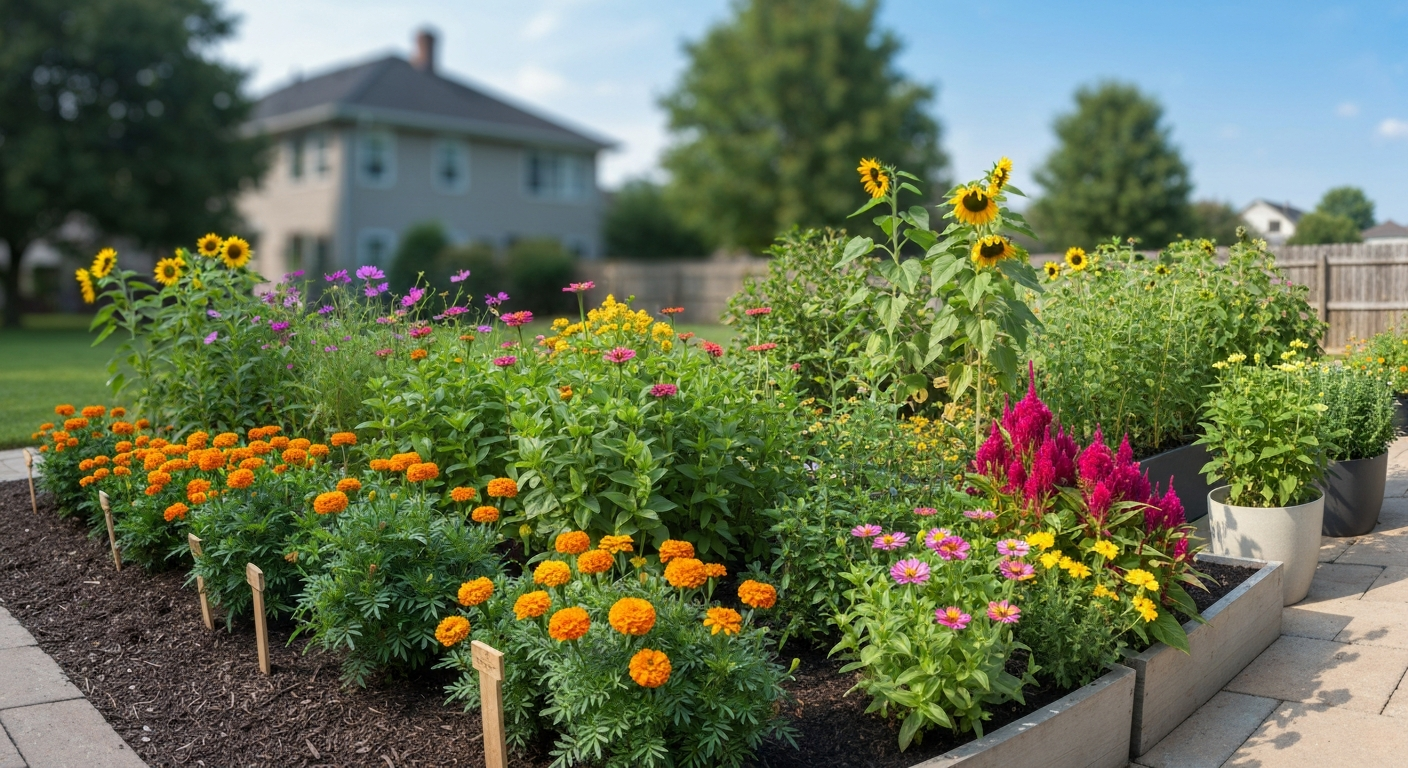
Who this guide is for
If you've ever bought a seed packet, stared at it for a few weeks, and then missed the planting window, this guide is for you. It's aimed at beginner and intermediate gardeners who want real, specific instructions rather than vague advice. By the time you finish reading, you'll have a planting schedule, a checklist to follow from seed to first bloom, and enough variety knowledge to make smart choices for your space. Whether you're working with a 10-foot border, a raised bed, or a cluster of pots on a deck, the approach is the same, just scaled to your situation. And if summer is what you're focused on now, keep in mind that the same planning mindset applies when you're thinking about spring flowers or year-round color, too.
Choosing summer-friendly varieties
Not every flower thrives in summer heat, and choosing the wrong variety is one of the most common reasons beginners get frustrated. The flowers below are proven summer performers that hold up in warm conditions, reward consistent deadheading, and are genuinely forgiving for first-time growers.
Marigolds
Marigolds (Tagetes spp.) are one of the easiest summer annuals you can grow, and they double as a natural pest deterrent in the bed. French marigolds are the fastest, many bloom in around 50 days from sowing. African types grow taller and take closer to 70 days, but the flowers are larger. Sow seeds about 1/4 inch deep. Marigolds handle heat well once established and keep producing as long as you keep removing spent blooms.
Zinnias
Zinnias (Zinnia elegans and Z. marylandica) are the workhorses of a summer cutting garden. They love heat, bounce back from drought better than most annuals, and produce flowers non-stop from midsummer until frost if you deadhead regularly. Sow barely covered, no deeper than 1/4 inch, directly into warm soil (around 65 to 70°F). Expect blooms in 60 to 90 days depending on the cultivar. I've had Benary's Giant varieties blooming in about 65 days when the soil was properly warm at sowing.
Cosmos
Cosmos (Cosmos bipinnatus) are airy, daisy-like flowers that thrive on neglect once established. Sow on the surface or no deeper than 1/8 inch, they need light to germinate well. At soil temperatures of 70 to 75°F, you'll see sprouts in 7 to 10 days, and flowers arrive 75 to 90 days after sowing. One thing to know: rich soil actually works against cosmos. They flower best when they have to work a little, so skip the heavy fertilizing.
Sunflowers
Sunflowers (Helianthus annuus) are direct-sow only, they hate having their roots disturbed, so transplanting rarely goes well. Sow 1/2 to 1 inch deep once soil reaches at least 55 to 65°F. Fast cut-flower types can bloom in as little as 50 to 60 days; branching varieties take closer to 70 to 90 days but give you multiple flushes of stems. Spacing matters a lot: dwarf varieties can go 6 to 9 inches apart, while branching giants need 12 to 30 inches.
Snapdragons
Snapdragons (Antirrhinum majus) are a bit different from the others, they prefer cool weather and actually struggle in peak summer heat. For summer blooms, start them indoors 6 to 10 weeks before your last frost date and get transplants in the ground while nights are still cool. The RHS notes that Antirrhinum (snapdragon) seeds are extremely small and require surface sowing with light, and that seedlings are typically started indoors about 6–10 weeks before transplanting RHS Antirrhinum (snapdragon) trial & cultivation notes. The seeds are tiny and need surface sowing with light to germinate (don't cover them). They'll bloom in late spring or early summer and often get a second wind once the heat of August passes. In warmer climates, snapdragons do better as fall or overwintering plants.
Cutting-garden staples: celosia, cosmos and more
For a proper cutting garden, celosia is worth adding to the list. It's heat- and drought-tolerant once established, sows easily at 1/8 to 1/4 inch depth, and blooms 60 to 90 days from sowing. Start indoors 4 to 6 weeks before your last frost or direct-sow 1 to 2 weeks after it passes. Sweet peas are cool-season climbers best sown in early spring rather than high summer, so save those for a spring planting plan. Lisianthus is a beautiful cut flower but requires months of careful indoor production, rewarding for dedicated growers, but not a beginner's first-summer project.
Quick-bloom vs long-season: variety picks for continuous color
Mixing quick-blooming varieties with longer-season types is the simplest way to keep color going from June through September. Here's a practical breakdown of what to expect from the most reliable summer flowers.
| Flower | Days to First Bloom | Bloom Season | Best Use | Heat Tolerance |
|---|---|---|---|---|
| French Marigold | 50–60 days | Early summer to frost | Borders, containers, edging | High |
| African Marigold | 60–70 days | Midsummer to frost | Beds, back of border | High |
| Zinnia (Benary's Giant) | 60–70 days | Midsummer to frost | Cutting garden, beds | Very high |
| Zinnia (Profusion) | 55–65 days | Early summer to frost | Containers, edging | Very high |
| Cosmos (Sensation) | 75–90 days | Midsummer to frost | Borders, cutting garden | Moderate-High |
| Sunflower (cut-stem types) | 50–65 days | Mid to late summer | Cutting garden | High |
| Sunflower (branching) | 70–90 days | Late summer | Beds, large containers | High |
| Snapdragon | 70–90 days from seed | Late spring/early summer | Cutting garden, borders | Low (cool-season) |
| Celosia | 60–90 days | Midsummer to frost | Cutting garden, containers | Very high |
For true continuous color, I'd recommend planting French marigolds and Profusion zinnias for early color, then letting Benary's Giant zinnias and cosmos fill in from midsummer onward. Celosia extends the back half of summer beautifully and holds up when everything else starts to look ragged in August heat. Succession sowing (more on that below) takes this even further.
Beds, borders and containers: how your site changes the approach
Where you're growing flowers affects almost every decision downstream, how often you water, how much you fertilize, and which varieties make sense. In-ground beds and borders give roots unlimited access to soil moisture and nutrients, which means plants tend to be more forgiving of missed waterings. Containers are more demanding: they dry out faster, lose nutrients through leaching more quickly, and can overheat in direct sun when the pot walls absorb heat. That said, containers give you flexibility to move plants, change compositions, and grow in spaces with no soil access at all.
In borders, tall varieties like African marigolds, cosmos, and branching sunflowers work well at the back, with French marigolds and compact zinnias at the front. In containers, stick to varieties described as 'compact,' 'dwarf,' or 'container-friendly', Profusion zinnias, French marigolds, and dwarf celosia all do well in pots. For containers, choose the largest vessel you can practically manage: bigger pots hold moisture longer and give roots room to develop.
Soil and container prep: getting the foundation right
In-ground beds
Good bed prep makes everything easier from here on. Loosen the soil to 8 to 12 inches deep, a digging fork works better than a spade for this. Work in well-rotted compost, but don't overdo it. Extension guidance and standard horticultural practice recommends no more than about 20 to 30% compost by volume; more than that and you can actually create drainage problems and overly lush, floppy growth. Hartmann & Kester, Plant propagation / propagation media guidance (textbook) recommends limiting raw compost to roughly 20–30% by volume and using a well‑draining soilless mix (bark/perlite/coir) with near‑neutral pH for most container mixes Hartmann & Kester — Plant propagation / propagation media guidance (textbook). Check your pH if you can, most summer annuals prefer a pH of about 6.0 to 7.0, and a basic soil test from your local extension office will tell you if you need to adjust. Good drainage is non-negotiable: if water pools after rain, raise the bed or work in perlite or coarse grit.
Containers and pots
Never use straight garden soil in pots, it compacts badly and drains poorly. Use a quality soilless potting mix based on bark, perlite, or coir, with a target pH of 6.0 to 7.0. You can blend in up to 20 to 30% compost by volume, but keep the mix light. Make sure every container has drainage holes; if it doesn't, drill some or use it as a decorative sleeve over a draining inner pot. When you water a 5-gallon container, you need to apply roughly 2.5 to 3 gallons to fully wet the root zone, water slowly until you see steady drainage from the bottom, then stop. Containers leach nutrients fast, so either mix in a slow-release fertilizer at potting time or plan to start water-soluble feeding about 6 to 8 weeks after planting.
Direct sow vs indoor starts: which to choose and when
This is one of the decisions that trips up a lot of beginners, and it's really not complicated once you understand the logic. Direct sowing is simpler, cheaper, and works well for any variety that germinates and grows quickly once the soil is warm. Indoor starting buys you weeks of head start, which matters for slow-maturing crops or when your growing season is short.
- Direct sow: zinnias, sunflowers, cosmos, marigolds (after last frost, once soil is at the right temperature for each)
- Start indoors: snapdragons (6–10 weeks before transplant date), celosia (4–6 weeks before last frost), slow-maturing cut-flower crops like lisianthus
- Either method works for marigolds and celosia, depending on how early you want blooms
- For direct-sow crops, check soil temperature rather than just the calendar — zinnias and cosmos want 65 to 70°F soil; sunflowers are fine from 55°F
- Harden off all indoor-started seedlings over 7 to 10 days before transplanting: start with a few hours of filtered shade outdoors, then gradually increase sun exposure and overnight time before planting out permanently
I'll be honest: I've lost a few batches of zinnias by sowing too early into cold, wet soil. They sit there, rot, and nothing happens. Waiting an extra week or two for the soil to warm properly is always worth it. If you're unsure of your last frost date, your local cooperative extension office is the most reliable source, online frost date calculators using your zip code are also accurate enough for home gardening purposes.
Planting schedule and sowing timelines
The table below gives sowing and transplant timing relative to your last frost date (LFD) and the target soil temperatures for direct-sown crops. Adjust these dates using your actual local last frost. In USDA Zones 6 to 7, last frost typically falls in mid-April to early May. Zones 8 to 9 are earlier (February to March); Zones 4 to 5 are later (mid-May to early June).
| Flower | Propagation | Sow Depth | Start Indoors | Direct Sow / Transplant Out | Min. Soil Temp | Days to Bloom | Spacing |
|---|---|---|---|---|---|---|---|
| French Marigold | Either | 1/4" | 4–6 wks before LFD | After LFD, soil ~70°F | 70°F | 50–60 days | 6–9" |
| African Marigold | Either | 1/4" | 4–6 wks before LFD | After LFD, soil ~70°F | 70°F | 60–70 days | 10–12" |
| Zinnia | Direct sow preferred | 1/8–1/4" | Not recommended | After LFD, soil 65–70°F | 65°F | 60–90 days | 6–12" |
| Cosmos | Direct sow preferred | Surface–1/8" | 4–6 wks before LFD (optional) | After LFD, soil ~70°F | 65°F | 75–90 days | 12–18" |
| Sunflower | Direct sow only | 1/2–1" | Not recommended | After LFD, soil 55–65°F | 55°F | 50–90 days | 6–30" (by type) |
| Snapdragon | Indoors only | Surface (needs light) | 6–10 wks before transplant | Before heat; cool nights | N/A | 70–90 days | 6–12" |
| Celosia | Either | 1/8–1/4" | 4–6 wks before LFD | 1–2 wks after LFD | 65°F | 60–90 days | 6–12" |
| Sweet Pea | Direct sow | 1–2" | Early spring only | Early spring (cool season) | 45–55°F | 60–90 days | 6" |
For succession planting, which is simply sowing the same variety at regular intervals to keep blooms coming, a 7 to 14 day interval between sowings works well for zinnias, marigolds, and sunflowers. Keep succession sowing until about 10 to 12 weeks before your first fall frost date. After that cutoff, new sowings won't have enough time to reach bloom before cold shuts them down. Growing flowers all year round requires a broader seasonal calendar, but summer succession sowing is one of the simplest ways to start thinking in those longer cycles.
Step-by-step planting guide: seed to first bloom
Follow this sequence and you'll avoid the most common beginner mistakes. I've organized it as a checklist you can work through from the moment you open your seed packets.
Stage 1: Before you sow
- Check your last frost date and calculate your sow-by dates using the table above
- Prepare beds by loosening to 8–12 inches and incorporating compost (no more than 20–30% by volume)
- Test or estimate soil pH — aim for 6.0 to 7.0 for all the varieties covered here
- Fill containers with a quality soilless potting mix; add slow-release fertilizer granules at potting time if using containers
- Check soil temperature with a thermometer before direct sowing — don't rely only on the calendar
- For indoor starts, fill cell trays or small pots with a fine seed-starting mix, not heavy potting soil
Stage 2: Sowing
- Sow at the correct depth for each variety (see table — cosmos and snapdragons go at or near the surface; sunflowers go deeper at 1/2 to 1 inch)
- Water gently after sowing — a fine mist avoids washing seeds out of position
- Label everything immediately; seeds look identical in trays
- For indoor starts, keep trays in a warm location (65–75°F) until germination; most summer annuals don't need grow lights to germinate but benefit from bright light once sprouts appear
- Expect germination in 4–14 days for marigolds, 7–10 days for cosmos, 7–21 days for snapdragons
Stage 3: Seedling care and hardening off
- Thin direct-sown seedlings once they reach 2–3 inches tall — crowded seedlings compete for light and airflow, which invites disease
- Water indoor seedlings from the bottom when possible to keep foliage dry and reduce damping off
- Begin hardening off indoor starts 7–10 days before transplant date: set trays outside in a sheltered, shaded spot for 2–3 hours on day one, then gradually increase time and sun exposure each day
- By day 7–10, plants should be spending full days outside and tolerating direct sun before you transplant them permanently
Stage 4: Transplanting
- Transplant on a cloudy day or in the evening to reduce transplant shock
- Water the transplant holes before placing seedlings in them
- Set seedlings at the same depth they were growing in their tray — don't bury the stem unless you're working with tomatoes (not applicable here)
- Firm soil gently around roots and water well immediately after planting
- Apply 2–3 inches of mulch around (not against) the base of transplants to retain moisture and suppress weeds
Stage 5: Ongoing care through first bloom
- Water consistently: in-ground plants need about 1 inch of water per week; containers may need daily watering in heat — check by pressing a finger 1 inch into the soil
- For containers, water until it runs freely from drainage holes, applying roughly 2.5–3 gallons per 5-gallon container
- Begin feeding container plants with water-soluble fertilizer every 2–3 weeks starting about 6–8 weeks after planting; use a balanced formula (such as 10-10-10 or similar) at label rates
- For in-ground beds, a light side-dressing of balanced granular fertilizer or compost midseason is usually sufficient — avoid over-feeding cosmos, as excess nitrogen produces foliage at the expense of flowers
- Deadhead spent blooms on marigolds, zinnias, and celosia at least once a week to redirect energy into new flower production
- For snapdragons and cosmos, cutting stems all the way back to a lateral bud (rather than just pinching off the flower head) produces better regrowth
- Watch for aphids, spider mites, and powdery mildew — more on those below
Sun, water and fertilizer: the quick-reference breakdown
| Flower | Sun Requirement | Water Needs | Fertilizer Notes |
|---|---|---|---|
| Marigold | Full sun (6+ hrs) | Moderate; drought-tolerant once established | Light feeder; balanced granular at planting |
| Zinnia | Full sun (6–8 hrs) | Moderate; tolerates short dry spells | Light to moderate; avoid excess nitrogen |
| Cosmos | Full sun | Low once established; prefers lean soil | Minimal; heavy feeding reduces flowering |
| Sunflower | Full sun (6–8 hrs) | Moderate; deep watering preferred | Moderate; balanced fertilizer at planting |
| Snapdragon | Full sun to part shade | Regular; dislikes drought | Moderate; water-soluble feed every 2–3 wks |
| Celosia | Full sun | Low-moderate; very heat-tolerant | Light; slow-release at planting is enough |
Managing heat stress in midsummer
The stretch from mid-July through August is when even the most heat-tolerant flowers can look ragged if you're not paying attention. Wilting in the morning is a red flag, by late afternoon, some wilting in full sun is normal and doesn't necessarily mean the plant is struggling. If plants haven't perked up by the next morning, water more deeply and consider adding mulch.
- Apply 2–3 inches of mulch (shredded bark, straw, or grass clippings) around plants to keep soil cool and retain moisture — this alone can reduce watering frequency significantly
- Water in the early morning rather than midday so foliage dries quickly and roots absorb moisture before peak heat
- For containers, move pots to a spot with afternoon shade during heatwaves — morning sun and afternoon shade is actually ideal for most annuals during extreme heat
- Snapdragons will pause blooming in midsummer heat; cut them back by about a third and they'll often rebound with a second flush when temperatures drop in late August
- If zinnias develop powdery mildew (white dusty coating on leaves) in humid heat, improve airflow by thinning crowded plants and avoid overhead watering
Common pests and diseases with targeted fixes
Most summer flower problems are predictable and manageable once you know what to look for. Catching issues early is always easier than trying to reverse damage that's already widespread.
| Problem | What You'll See | Likely Cause | Fix |
|---|---|---|---|
| Aphids | Clusters of tiny green/black insects on new growth; sticky residue | Warm weather, new growth flushes | Blast off with water; apply insecticidal soap if persistent |
| Spider mites | Fine webbing under leaves; stippled, pale foliage | Hot, dry conditions | Increase watering; apply neem oil or insecticidal soap |
| Powdery mildew | White powder on zinnia and phlox leaves | Humid air with poor circulation | Improve spacing; remove affected leaves; apply dilute neem oil |
| Damping off (seedlings) | Seedlings collapse at soil level | Wet, cool soil; overwatering | Improve drainage; water from bottom; use sterile seed mix |
| Slugs | Irregular holes in leaves overnight | Moist conditions near mulch | Reduce mulch contact with stems; use slug bait around beds |
| Leaf miners | Winding pale trails inside leaves | Leaf miner fly larvae | Remove and destroy affected leaves; tolerant in most cases |
| Heat wilt (non-disease) | Midday wilting that recovers by morning | Temporary heat stress | Deep watering; mulch; afternoon shade for containers |
Deadheading, cutting and harvesting for more blooms
Deadheading is the single most impactful maintenance task for keeping summer flowers producing. When a flower is allowed to set seed, the plant's energy shifts toward seed production and flower output drops sharply. For marigolds and zinnias, snap or snip off spent blooms at the base of the flower stem, just above the next set of leaves. For cosmos and snapdragons, cut the entire stem back to a lateral shoot rather than just pinching the head.
For cutting-garden flowers, harvest stems in the early morning when they're fully hydrated. Cut zinnias and marigolds when the flowers are fully open but before petal edges begin to fade. Sunflowers should be cut when the petals have just unfurled and the center is still firm. Plunge stems immediately into cool water and let them condition for several hours before arranging. Zinnias and celosia are particularly long-lasting in the vase, often 7 to 10 days with fresh water every day or two.
Succession planting to extend bloom all season
The most reliable way to have flowers continuously from June through September is to sow the same varieties in waves rather than all at once. For zinnias and marigolds, sow a new batch every 7 to 14 days from your last frost date until about 10 to 12 weeks before your first fall frost. That cutoff ensures each sowing has enough time to reach bloom before cold ends the season. For cosmos and sunflowers, two to three succession sowings are usually enough because they bloom over a longer window anyway. Keeping a simple notebook with sow dates and variety names makes it easy to look back and refine your timing the following year, something I wish I'd started doing in my first season.
Planning beyond summer
Once you've got your summer planting rhythm down, it's natural to start thinking about what comes before and after. Spring flowers like sweet peas, snapdragons, and poppies require a different timing framework, cool soil and early sowing are the key factors there, which is worth exploring in a dedicated spring planting guide. If you want to keep your garden in bloom from late winter through late fall without a gap, thinking through a full seasonal rotation across your beds and borders will help you sequence planting so something is always coming into flower as the previous flush finishes. For help sequencing plantings across spring, summer, and fall, see our guide on how to grow seasonal flowers to plan a full-season rotation. For a full seasonal plan, see our guide on how to grow flowers all year round. That's a bigger planning exercise, but it starts with exactly what you've just done here: understanding each flower's pace from seed to bloom and building your schedule around it.
FAQ
Which summer flower varieties are easiest and most reliable for beginners in beds, borders and containers?
Choose quick, heat-tolerant, and forgiving annuals: marigolds (French and African types), zinnias (Z. elegans and Z. marylandica), cosmos, celosia, sunflowers (dwarf and branching types), snapdragons (cool parts of summer or early/late plantings), and common wildflower mixes for easy drifts. For cutting gardens add fast repeat-bloomers like zinnias, cosmos, sunflowers and celosia. For longer-season color mix quick-blooming (zinnia, cosmos, marigold) with longer-season performers (some sunflower types, celosia).
When should I start seeds indoors vs direct-sow for summer flowers? Give exact timing guidelines.
General rules: direct-sow heat-tolerant annuals after soil temps reach the crop minimum; start slow/tender or tiny-seeded crops indoors. Examples: - Marigolds: start indoors 4–6 weeks before last frost OR direct-sow after soil warms to ~70°F. - Zinnias: direct-sow after last frost when soil ~65–70°F; can start indoors 3–4 weeks earlier. - Cosmos: direct-sow after last frost; or start 4–6 weeks early. - Sunflowers: direct-sow after last frost when soil ≥55–65°F. - Snapdragons: start indoors 6–10 weeks before transplant; plant out in cool window (spring/early summer or fall in warm climates). Use a seed-starting date calculator (enter local last-frost date and days‑to‑first-bloom) to set exact dates.
What are clear sowing timelines and a simple planting schedule I can follow from seed to bloom?
Simple schedule template (adjust by local last-frost and days-to-bloom): - Week 0 (4–10 weeks before last frost): start slow germinators indoors — snapdragons (6–10 wks), lisianthus (very early). - Week 3–6 before last frost: start marigolds, celosia, cosmos (4–6 wks if transplanting). - Last-frost to +2 weeks: direct-sow zinnias, cosmos, sunflowers, wildflowers when soil warms. - 2–8 weeks after transplant/direct-sow: thin/space seedlings, begin regular care. - 6–12+ weeks after sowing/transplant: first flowering window (varies by crop: French marigolds ~50–70 days; zinnias 60–90; cosmos 75–90; many sunflowers 60–90). Succession: sow replacements every 7–14 days for continuous blooms until cutoff calculated as (average days-to-bloom + desired harvest window) before first fall frost.
How should I prepare soil and container mixes before sowing or transplanting?
In-ground beds: loosen 8–12" deep, remove large debris, correct pH from soil test, and incorporate 1–3" of well-rotted compost (typical preplant fraction) for drainage and fertility. Containers: use a well-draining soilless mix (coir/bark/perlite) with ≤20–30% compost and pH ~6.0–7.0. Ensure containers have drainage holes. For both, avoid heavy raw manures and poor-draining clay pockets; amend as needed for drainage.
What exact sun, water and fertilizer prescriptions work best for common summer flowers?
Sun: most summer annuals need full sun (≥6–8 hours/day). Snapdragons prefer cooler sun/part shade in hottest climates. Water: in beds water deeply to 6–8" soil depth 1–2×/week depending on rainfall; in hot weather many containers need daily watering—water until runoff and avoid allowing containers to dry completely. As a rule, water containers until ~45–60% of volume is wetted (e.g., fully wet a 5‑gal pot requires ~2.5–3 gal). Fertilizer: in beds incorporate balanced slow‑release at planting per product label; in containers use controlled‑release incorporated at potting or start water‑soluble feeds 2–3 weeks after planting, then every 2–3 weeks at label rates. Feed heavier feeders (zinnias, sunflowers) moderately; light feeders (cosmos) need less. Follow manufacturer rates for CRF grams per container.
How do I manage heat, drought and sun stress on summer flowers?
Mulch beds with 2–3" organic mulch to reduce soil temps and conserve moisture. Use morning watering to reduce disease and provide deep soakings; in extreme heat use twice-daily shallow watering for containers only if plants show stress (morning and late afternoon), but avoid wet foliage mid-afternoon. Provide temporary shade cloth (30–50% shade) for recently transplanted or shade‑sensitive seedlings during heat waves. Use mulch, consistent watering, and avoid fertilizing during extreme heat spikes. Choose heat-tolerant varieties (celosia, marigolds, zinnias) for hottest zones.
Next Articles
How to Grow Flowers Outside: Step by Step Guide
Step-by-step guide to growing outdoor flowers in-ground or containers, from choosing plants to watering, feeding, and tr
How to Grow Flowers All Year Round: Step-by-Step Plan
Step-by-step plan to grow flowers all year round with succession planting, seasonal varieties, sowing timeline, and wint
How to Grow Seasonal Flowers: Step-by-Step Guide
Step-by-step plan to grow seasonal, seed-grown flowers with timing, sowing, soil, care, and a planting checklist.